If you’re planning to build a high-end gaming PC in 2026, comparing the AMD Ryzen 9 9900X3D vs AMD Ryzen 7 9800X3D is something you simply can’t skip. Both processors are part of AMD’s powerful X3D lineup, built specifically for gamers and powered by advanced 3D V-Cache technology that boosts in-game performance.
Many users still get confused and assume these CPUs belong to Intel, but that’s not true both the Ryzen 9900X3D and 9800X3D are developed by AMD for top-tier gaming and efficiency.
In this guide, we’ll compare the Ryzen 9900X3D vs Ryzen 9800X3D in terms of real-world gaming performance, core specifications, efficiency, and overall value, helping you choose the right CPU for your gaming build with confidence.
Why AMD X3D Technology Matters for Gamers?
To understand the real difference between the AMD Ryzen 9 9900X3D vs AMD Ryzen 7 9800X3D, it’s important to first understand the role of AMD’s 3D V-Cache technology. This innovation works by stacking L3 cache vertically on top of the processor die, allowing the CPU cores to access a much larger pool of ultra-fast memory directly. Instead of constantly depending on slower system RAM, the processor can retrieve frequently used game data instantly from this expanded cache layer.
Vertical Cache Stacking Efficiency
One of the key strengths of AMD Ryzen 9 9900X3D vs AMD Ryzen 7 9800X3D comes from vertical cache stacking efficiency. With AMD’s 3D V-Cache design, an additional 64MB of L3 cache is stacked directly onto the core complex die, significantly expanding the amount of high-speed memory available to the processor. This architecture reduces the need to frequently access slower system RAM, allowing game data to stay much closer to the CPU cores. As a result, modern games benefit from higher frame rates, improved responsiveness, and noticeably smoother performance in demanding gaming scenarios.
Drastic Latency Reduction for Gamers:
Lower latency in the AMD Ryzen 9900X3D vs 9800X3D improves gaming performance by reducing memory access time. With AMD 3D V-Cache, data stays closer to CPU cores, resulting in higher minimum FPS, fewer micro-stutters, better frame pacing, and a smoother overall gaming experience in demanding modern titles.
Perfecting 1% Lows and Stability:
The AMD Ryzen 9 9900X3D vs Ryzen 7 9800X3D comparison highlights one major strength of AMD’s X3D lineup—exceptional 1% low performance and frame time stability. Thanks to AMD’s 3D V-Cache technology, the processor can maintain a large pool of fast-access data close to the CPU cores, which helps keep frame delivery consistent even under heavy gaming loads.
This results in much smoother gameplay during demanding situations such as explosions, large open-world environments, or intense multiplayer battles, where CPU usage spikes suddenly. Instead of experiencing sudden drops or micro-stutters, the system maintains stable frame pacing, which is critical for competitive and high-refresh-rate gaming.
Detailed Analysis of Ryzen 9 9900X3D vs Ryzen 7 9800X3D
The comparison between AMD Ryzen 9 9900X3D vs Ryzen 7 9800X3D highlights a key architectural difference that directly impacts performance and use cases. The 9800X3D is designed with a more streamlined, gaming-focused approach that prioritizes ultra-low latency and fast responsiveness through an efficient single-chiplet structure. This makes it highly optimized for pure gaming performance, where speed and frame consistency matter most.
On the other hand, the 9900X3D takes a more advanced multi-chiplet design approach, delivering higher core scalability and better multitasking capability. This allows it to handle demanding professional workloads such as content creation, rendering, and heavy productivity tasks while still maintaining strong gaming performance.
Core Specifications
To understand the real difference between AMD Ryzen 9 9900X3D vs Ryzen 7 9800X3D, it’s important to look at their core specifications. Both processors are built on the Zen 5 architecture and use the AM5 platform, but they target different types of users based on performance design and workload focus.
The Ryzen 9 9900X3D comes with a higher core count and a dual-CCD design, making it more suitable for multitasking and productivity-heavy workloads. In contrast, the Ryzen 7 9800X3D uses a simpler single-CCD design, which helps it achieve lower latency and stronger gaming efficiency.
Below is a clear specification comparison:
- Cores / Threads: 9900X3D – 12C / 24T | 9800X3D – 8C / 16T
- Chiplet Design: 9900X3D – Dual CCD (6+6) | 9800X3D – Single CCD (8+0)
- Base Clock: 9900X3D – 4.4 GHz | 9800X3D – 4.7 GHz
- Boost Clock: 9900X3D – Up to 5.5 GHz | 9800X3D – Up to 5.2 GHz
- L3 Cache: 9900X3D – 128 MB | 9800X3D – 96 MB
- TDP: Both – 120W
- Socket: AM5 for both
- Architecture: Zen 5 for both
Best Use Case
- Ryzen 9 9900X3D: Ideal for hybrid users who need both gaming and productivity performance
- Ryzen 7 9800X3D: Best choice for pure gaming-focused builds where latency and FPS stability matter most
Why Choose AMD Ryzen 7 9800X3D?
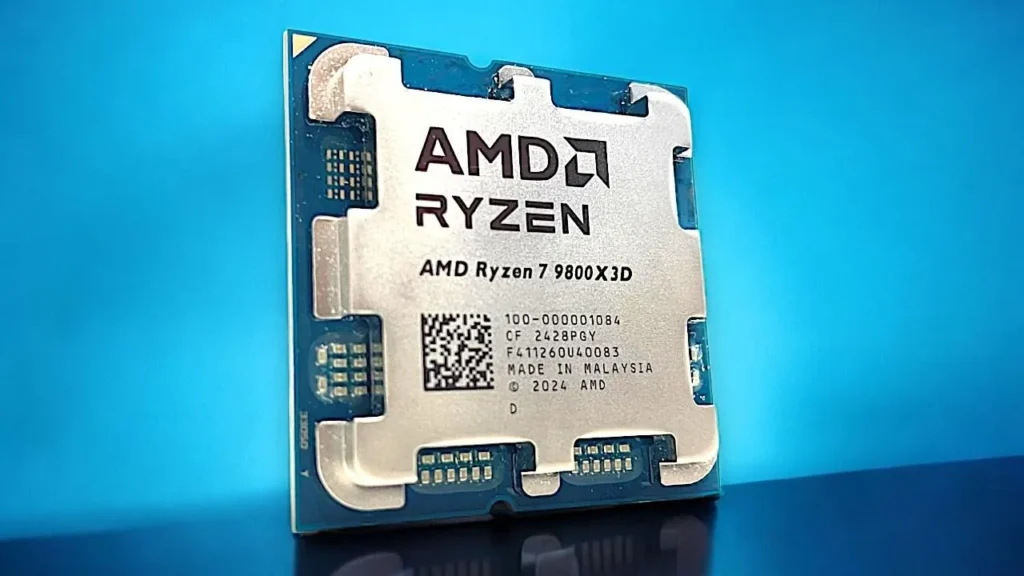
If you’re building a high-performance gaming PC, the AMD Ryzen 7 9800X3D stands out as one of the strongest options in the AMD Ryzen 9 9900X3D vs Ryzen 7 9800X3D comparison. It is built with a pure gaming focus, offering exceptional speed, efficiency, and stable frame delivery for competitive and high-refresh-rate gaming setups.
Reasons to Buy
Top-Tier Gaming Performance:
The Ryzen 7 9800X3D delivers extremely high FPS in competitive games, making it ideal for 240Hz and 360Hz high-refresh-rate monitors without CPU bottlenecks.
Low Latency Architecture:
Its single-CCD design reduces communication delays, improving responsiveness, faster input reaction, and smoother overall gameplay.
Excellent Thermal Efficiency:
With only 8 cores, it runs cooler and more efficiently than higher-core CPUs, making cooling easier and more cost-effective.
Strong Gaming Value:
Offers best-in-class FPS per dollar in the high-end segment, allowing more budget to be invested in a powerful GPU for better visuals.
Stable Frame Times:
Provides consistent 1% lows and smooth frame pacing, reducing stutters in CPU-heavy and fast-action gaming scenarios.
Reasons to Avoid
Limited Productivity Power:
Not ideal for heavy workloads like 4K video editing, rendering, or simulation tasks compared to higher-core processors.
Weaker Multitasking Ability:
May struggle when running multiple heavy applications simultaneously, such as gaming, streaming, and editing together.
Not a Workstation CPU:
Lacks extra cores needed for professional creative and engineering workloads.
Lower Future Scalability:
8 cores may become a limitation as future software demands more parallel processing power.
Why Choose AMD Ryzen 9 9900X3D?
If you’re comparing the AMD Ryzen 9 9900X3D vs Ryzen 7 9800X3D, the decision mainly depends on whether you need a pure gaming CPU or a hybrid workstation-class processor. The Ryzen 9 9900X3D is designed as a high-end dual-purpose chip that combines strong gaming performance with serious productivity power, making it ideal for creators, professionals, and gamers who want one system for everything.
With its 12-core, 24-thread configuration, the 9900X3D is built for heavy multi-threaded workloads while still benefiting from AMD’s 3D V-Cache technology for gaming performance
Reasons to Buy
1. Hybrid Workstation + Gaming Power
The Ryzen 9 9900X3D is designed for users who do more than just gaming. It handles video editing, 3D rendering, coding, and productivity workloads efficiently while still delivering high-end gaming performance.
2. Excellent Multithreaded Performance
With 12 cores and 24 threads, it delivers fast render times, smoother multitasking, and improved workflow efficiency for professional applications like Adobe Premiere Pro, Blender, and development tools.
3. Strong Streaming Capability
Its extra cores allow you to stream and game simultaneously without heavily impacting in-game performance. OBS encoding and background tasks can run smoothly alongside gaming.
4. Large L3 Cache Advantage
The 3D V-Cache improves both gaming responsiveness and certain data-heavy professional workloads, especially simulations and cache-sensitive applications.
5. Future-Proof Performance Headroom
Higher core count and stronger multitasking capability make it more suitable for future software demands and next-gen productivity workloads.
Reasons to Avoid
1. Higher Total Platform Cost
This CPU often requires premium cooling (360mm AIO recommended) and a stronger PSU, increasing the overall build cost significantly compared to gaming-focused chips.
2. Slight Gaming Latency Trade-Off
Due to its dual-CCD design, some latency-sensitive games may perform slightly better on the Ryzen 7 9800X3D, especially in competitive esports titles.
3. Overkill for Pure Gamers
If your focus is only on gaming, the extra cores will not provide meaningful FPS gains compared to a more gaming-optimized CPU.
4. More Complex Architecture
The split CCD design can sometimes lead to uneven core utilization in specific games or workloads if not properly optimized.
5. Higher Power and Cooling Requirements
Under full load, it consumes more power and produces more heat, requiring stronger cooling solutions for stable performance.
.
9900X3D vs 9800X3D: Which One is Best for Gaming Performance?
When it comes to gaming, the comparison between the AMD Ryzen 9 9900X3D and the AMD Ryzen 7 9800X3D clearly shows that raw specifications like core count don’t always determine real-world performance. Instead, factors like cache design, latency, and how game engines utilize CPU resources play a much bigger role.
Architecture Differences That Impact Gaming
The biggest difference between these two CPUs lies in their internal design:
- 9800X3D (8-core, single CCD design)
- All cores share the same cache pool
- Direct access to 3D V-Cache
- No inter-chiplet latency
- 9900X3D (12-core, dual CCD design)
- Split across two chiplets
- Uneven access to 3D V-Cache
- Slight latency when cores communicate across chiplets
For gaming, lower latency and faster cache access are far more important than having extra cores.
Gaming Performance: FPS & Real-World Results
In real-world gaming benchmarks, the 9800X3D often performs equal to or better than the 9900X3D, especially in CPU-bound titles.
Why the 9800X3D wins in gaming:
- Games typically use 6–8 cores efficiently
- Extra cores on the 9900X3D often go unused
- Lower latency improves:
- Frame rates (FPS)
- Frame consistency (1% lows)
- Overall smoothness
Performance highlights:
- 9800X3D
- Higher or more stable FPS in most games
- Better frame pacing
- Ideal for competitive gaming
- 9900X3D
- Similar performance in some titles
- Slightly lower consistency in latency-sensitive games
- Better for multitasking scenarios
3D V-Cache: Why It Matters for Gamers
Both processors use AMD’s 3D V-Cache, but the way it’s implemented changes everything:
- 9800X3D
- Unified cache access across all cores
- Maximizes gaming performance
- 9900X3D
- Cache is limited to one chiplet
- Some cores experience higher latency
Game Optimization & Core Usage
Modern games are designed with console hardware in mind:
- Most consoles use 8-core CPUs
- Game engines are optimized for fewer, faster cores
What this means:
- The 9800X3D matches game engine design perfectly
- The extra cores in the 9900X3D provide minimal gaming benefit
Latency vs Core Count: What Matters More?
| Factor | Low Latency (e.g., AMD Ryzen 7 9800X3D) | High Core Count (e.g., AMD Ryzen 9 9900X3D) |
| Gaming FPS | Higher average FPS in most titles | Similar or slightly lower in some games |
| Frame Consistency (1% lows) | More stable and smoother gameplay | Slight dips due to latency overhead |
| Game Engine Optimization | Matches 6–8 core optimization | Extra cores often remain unused |
| Cache Efficiency | Unified and faster cache access | Uneven cache access across chiplets |
| Latency Impact | Minimal delay between cores | Cross-chiplet communication adds delay |
| Multitasking / Productivity | Limited by fewer cores | Strong advantage in heavy workloads |
| Power Efficiency | Lower power consumption | Higher power usage |
| Thermal Performance | Easier to cool | Requires stronger cooling solutions |
| Best Use Case | Pure gaming performance | Gaming plus productivity workloads |
Which CPU Should You Choose?
Choose the 9800X3D if you want:
- The best gaming performance
- Higher FPS and smoother gameplay
- Lower power consumption
- A CPU optimized for modern games
Choose the 9900X3D if you need:
- Gaming + streaming performance
- Better multitasking
- More cores for productivity workloads
Gaming Benchmarks Comparison (FPS Results)
Counter-Strike 2 (1080p, CPU-bound)
- Ryzen 7 9800X3D: ~680 FPS
- Ryzen 9 9900X3D: ~670 FPS
In real-world gaming, both CPUs perform very closely, but the 9800X3D has a small edge in esports and CPU-bound games because of its lower latency and single-CCD design.
9800X3D vs 9900X3D Pros and Cons
AMD Ryzen 7 9800X3D
Pros
- Excellent gaming performance with high FPS
- Lower latency due to single-CCD design
- Better frame consistency and smoother gameplay
- More power-efficient and easier to cool
- Strong value for high-end gaming builds
Cons
- Limited performance in heavy productivity tasks
- Fewer cores for multitasking
- Not ideal for professional workloads
AMD Ryzen 9 9900X3D
Pros
- Strong multi-core performance for productivity
- Great for streaming and multitasking
- Handles heavy workloads like rendering and editing
- More future-proof for multi-threaded applications
Cons
- Slightly higher latency in gaming scenarios
- Requires better cooling and more power
- Extra cores offer limited benefit for gaming alone
- Higher overall system cost
Best GPU Pairing for 9800X3D and 9900X3D
Choosing the right GPU is just as important as selecting the CPU.
For the 9800X3D:
- Best paired with high-end GPUs for maximum gaming performance
- Ideal combinations include GPUs capable of pushing high FPS at 1080p and 1440p
- Perfect for competitive gaming setups
For the 9900X3D:
- Works well with both high-end and enthusiast GPUs
- Better suited for users who game, stream, and create content on the same system
In general, both CPUs perform best when paired with powerful GPUs, but the 9800X3D is more focused on extracting every bit of gaming performance, while the 9900X3D balances gaming with productivity.
Cooling Requirements and Thermal Performance
Thermal performance is another important factor when choosing between these two processors.
The 9800X3D is more efficient:
- Runs cooler due to fewer cores
- Can be handled easily with a high-quality air cooler or a mid-range AIO
- Ideal for compact or quiet builds
The 9900X3D, however, demands more:
- Generates more heat under heavy workloads
- Performs best with a 360mm AIO liquid cooler
- Requires better airflow and case design
This difference also impacts long
Future-Proofing: Which CPU Will Last Longer?
Future-proofing depends on how you plan to use your system.
The 9900X3D has an advantage in:
- Multi-threaded workloads
- Future applications that may use more cores
- Long-term productivity performance
However, the 9800X3D remains highly relevant for gaming:
- Game engines are still optimized for 6–8 cores
- Latency improvements matter more than core count
- It will continue to deliver excellent gaming performance for years
So while the 9900X3D may age better in productivity scenarios, the 9800X3D will remain a strong gaming CPU well into the future.
Conclusion
When deciding between the AMD Ryzen 9 9900X3D vs AMD Ryzen 7 9800X3D for gaming, it’s important to consider your overall usage, not just raw specifications. If your focus is purely on gaming performance, the Ryzen 7 9800X3D stands out as the better choice. Its lower latency, efficient single-CCD design, and optimized cache access make it ideal for achieving higher FPS and smoother gameplay without the added cost of workstation-level hardware.
However, if you’re a power user who combines gaming with tasks like content creation, streaming, or heavy multitasking, the Ryzen 9 9900X3D becomes the more practical option. It delivers nearly the same gaming performance—often within a small margin—while offering significantly better multi-core performance for demanding workloads. This makes it a strong hybrid CPU that balances high-end gaming with professional productivity.
In simple terms, the Ryzen 7 9800X3D is the best CPU for pure gaming, while the Ryzen 9 9900X3D is the smarter long-term investment for users who need both gaming power and multitasking performance.
Frequently Asked Questions
AMD vs Intel: Gaming performance (2012–2021)
Between 2012 and 2017, Intel dominated gaming performance due to stronger single-core speed. However, from 2017 onward, AMD Ryzen processors significantly closed the gap and even surpassed Intel in some scenarios, especially with the introduction of 3D V-Cache.
How does IPC compare between AMD Ryzen and Intel Kaby Lake?
IPC (Instructions Per Clock) measures how much work a CPU can do per cycle. AMD Ryzen CPUs generally offer higher IPC than older Intel Kaby Lake processors, resulting in better efficiency and improved real-world performance.
What is multi-core mixed speed?
Multi-core mixed speed refers to a CPU’s ability to handle a combination of different workloads (integer, floating-point, and memory tasks) across multiple cores simultaneously. It reflects real-world multitasking performance.
What is multi-core integer speed?
This measures how efficiently a CPU handles integer-based calculations (like basic math and logic operations) across multiple cores. It’s important for general computing and some gaming workloads.
What is multi-core floating point speed?
Floating-point speed evaluates how well a CPU processes complex decimal calculations across multiple cores. This is especially important for tasks like 3D rendering, simulations, and scientific computing.
What is single-core mixed CPU speed?
Single-core mixed speed measures how well one CPU core handles a variety of tasks. It’s crucial for applications and games that rely heavily on single-threaded performance.
What is quad-core mixed CPU speed?
This measures the performance of four CPU cores working together on mixed workloads. It gives a balanced view of performance for modern applications that use multiple threads.
What is quad-core floating point speed?
This refers to how efficiently four cores handle floating-point calculations. It’s useful for workloads like video editing, physics simulations, and advanced graphical tasks.
What is quad-core integer speed?
Quad-core integer speed measures how well four cores process integer-based operations. It’s important for everyday computing and certain types of software processing.
What is single-core floating point speed?
This measures how well a single core handles complex decimal calculations. It’s important for specific tasks that rely on precision and cannot be parallelized.
What is single-core integer speed?
Single-core integer speed evaluates how efficiently one core performs basic calculations and logic operations. It plays a key role in system responsiveness and older applications.
What is the Geekbench single-core score?
The Geekbench single-core score measures the performance of one CPU core using standardized tests. Higher scores indicate better performance in tasks that rely on single-threaded processing.
What is a CPU?
A CPU (Central Processing Unit) is the main processor of a computer that executes instructions and performs calculations. It is often referred to as the “brain” of the system.
What is the effective CPU speed index?
The effective CPU speed index is a combined metric that estimates overall processor performance based on real-world workloads. It typically considers both single-core and multi-core capabilities.
What is overclocking?
Overclocking is the process of increasing a CPU’s clock speed beyond its factory settings to gain more performance. It requires proper cooling and can increase power consumption and heat output.
What is thermal design power (TDP)?
TDP refers to the amount of heat a CPU generates under typical load, measured in watts. It helps determine the type of cooling solution needed for stable performance.