


Have you ever heard that the insurance companies may take a lot of financial risks when their reserves are not calculated properly to meet the future claims? The Liability Adequacy Test (LAT) comes in this context, and it is a very crucial tool that helps in monitoring the financial maturity of companies to make their payments. In the absence of this test, organizations may fail to be at par during the economical changes or unexpected circumstances that may cause financial instability.
In this blog we will see how the Liability Adequacy Test is becoming more significant than ever, not only to insurance companies but also to any other business that entails long-term commitments. Not only will you learn how LAT works, but you will also learn the main assumptions underlying the method and how the method is used by organizations to eliminate financial risks.
We shall start by knowing why LAT is an effective instrument of financial stability and how it guarantees the ability of companies to fulfill their future obligations. We shall also explore how LAT is done step by step, what occurs when reserves are not sufficient and why it is vital to good financial governance. That is why, by the end, you will have a better perspective on how LAT helps to secure both businesses and stakeholders.
Why the Liability Adequacy Test is Crucial for Financial Health
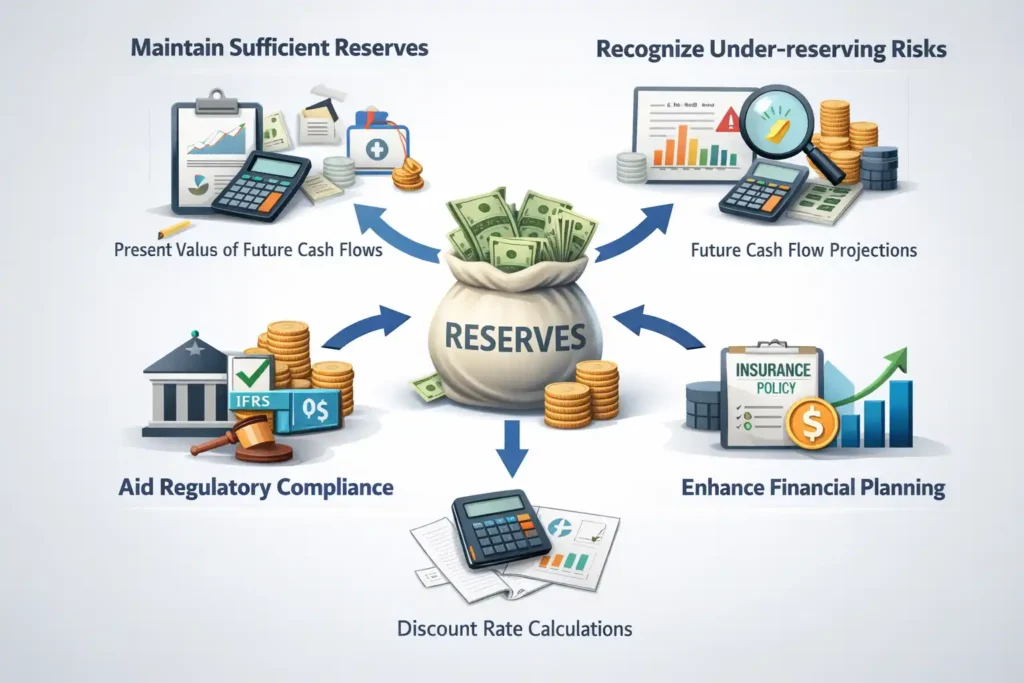
The Liability Adequacy Test (LAT) is a key process to guarantee that its reserves will be enough to meet future obligations of an organization. For insurance companies, this involves ensuring that they have sufficient reserves to pay out claims and other obligations over time. Here’s why you absolutely need LAT to remain financially sound and compliant:
Maintains Sufficient Reserve: LAT figures out if the current reserves would be able to pay for all future obligations. It does so by calculating the present value of future cash outflows related to claims, benefits, and expenses. This guarantees the company is monetarily able to pay its long-term obligations.
Recognizes Under-reserving Risks: LAT highlights under-reserving risks by utilizing future cash flow projections and the appropriate discount rates applied to these. If the estimated obligations exceed the reserves, it is an indication that more provisions should be made and financial estimates in the future must be altered.
Aids in Regulatory Compliance: LAT is generally a compliance, and it reflects the liabilities of the company. It measures actual current liabilities against the estimated future obligations and ensures that the company meets accounting standards such as IFRS, preventing shortfalls that could result in regulatory fines.
Enhanced Financial Planning: LAT allows businesses to hone their pricing and underwriting. If LAT tells us that reserves are insufficient, it means that either the price charged or underwriting criteria must change to put the company in a position of solvency.
The LAT, or the Liability Adequacy Test, is a method that tests whether an entity’s reserves are sufficient enough to satisfy its potential future obligations (claims, benefits, and contractually agreed payments). It gives a more in-depth look at whether the company has reserved sufficient funds as of today in respect of costs expected to be generated in the future.
What Does the Liability Adequacy Test Measure?
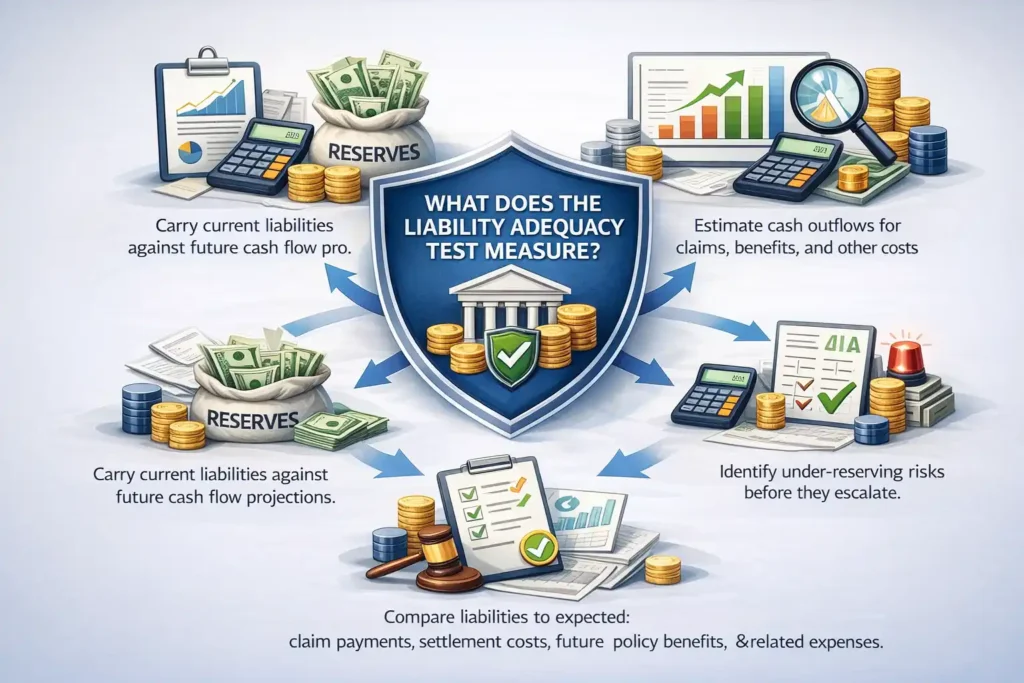
Assessing For An Adequacy Of Reserves: LAT measures if the reserves accumulated to date are enough to meet all liabilities in the future. This figure is inclusive of anticipated claims, policyholder benefits, and other financial exposures that would have to be met. The test determines whether the reserves we hold today are sufficient to satisfy what will be needed tomorrow, avoiding that our company lacks funds to pay claims.
Projections of Future Cash Flows: LAT projects all future cash outflows required to repay all obligations. That’s estimating the dollar amount required for claims, benefits, and administration over time. It projects these future cash outflows based on data, policy details, and claims experience going right back to the dawn of time and delivering a predictive measure of what will be needed to keep up with obligations as they fall due.
Risk Indicator: LAT is an early warning indicator based on the size of risks associated with under-reserving. Where anticipated future obligations are projected to surpass current reserves, LAT will detect this deficit early and allow the company time to beef up reserves, update its financial forecast, or adjust pricing and underwriting assumptions in response to an insufficient reserve position. This preemptive measure ensures the company isn’t financially crippled when liabilities overtake it.
LAT in action: A real-world example – Take a look at an insurance company that did not LAT correctly. If the company is not properly pursuing a reserve adequacy study, it may find itself blindsided by an economic downturn and a sudden surge of claims. When it does, the company becomes financially unstable, profitability will be lower, and stock value will fall, and in a worst-case scenario, it may not fulfill its legal obligations to policyholders, which can result in non-compliance with regulations as well as tarnishing the company’s reputation.
What Is Compared in the LAT?
LAT compares the carrying amount of liabilities (amounts already set aside) with future expected cash flows, which are:
Claims: Amounts paid to policyholders for the claims they submit.
Expense: Cost of handling and settling claims and issuing policies.
Values: The actual or promised payments or benefits to policy owners.
This benchmarking would also serve to validate the reserves that the company has in place and whether or not they are sufficient for future payment demands.
What Is Compared in the LAT?
LAT compares the value of liabilities (the reserves currently held) with future anticipated cash flows such as
Claims: Payments to policyholders for reported claims.
Loss-adjustment expenses: Expenses associated with the adjustment and processing of claims and policies.
Advantages: Payments or benefits that a policyholder is entitled to receive in future.
This benchmarking enables the firm’s reserves to measure up in what they need to pay out.
What Does the LAT Include?
If a candidate was asked, “What should be in the LAT?” On an exam, these are key components:
Claim Estimate Current Liability: The anticipated liability for payment of claims yet to be reported by insureds.
Settlement/Processing Costs: The expenses incurred in claims processing and settlement, administration and operation costs.
Future Policy Holders Benefits: The benefits that insurance in the policy holds, such as death benefit and annuities.
Other Costs: Other costs associated with compliance, such as taxes or policy management fees.
These considerations help ensure that the test accounts for all relevant costs and burdens associated with the company’s obligations.
Effect of the LAT Results
Loss Recognition: If LAT shows that the reserves are not adequate to cover future obligations, then a loss must be recognized. There will be an instantaneous economic correction in order to cover the deficit.
Rising Liabilities: The firm will also have to raise reserves to the level of the determined liability, so that it has enough money set aside for claims and obligations.
If Liabilities Are Adequate: If LAT shows that the reserves are sufficient, then no further adjustment would be required. The firm is able to trust in their old reserves while still being financially insured without having to act.
How the Liability Adequacy Test Works: Step-by-Step

The Liability Adequacy Test (LAT) has six technical steps followed in describing how the reserves of an organization are adequate to pay its future obligations. And every step would determine whether the company has enough money to pay claims, benefits, and other obligations.
Segment the Portfolio: LAT starts by classifying the portfolio into risk groupings. This is important because it’s the only way to make certain the test makes correct and properly calibrated projections of actual risk characteristics (e.g., policy type, claims history, geographic location). Precise segmentation allows the company to determine which regions may need more attention.
Estimate Future Cash Flows: LAT estimates the future net cash payments necessary to settle all obligations, including claims, policy benefits, and administrative costs. With the help of historical claims data and economic factors, LAT estimates how much will be necessary to cover future liabilities. These estimates give you a likely number for how much to set aside.
Apply Assumptions In order to make meaningful forecasts, LAT makes certain assumptions, like frequency of claims, rates of inflation, and policy lapses. Please pay special attention to the forwards and the reasons behind them. The assumptions are based on historical results, industry trends and conditions, and economics. It is also important to regularly update the LAT in order for it to continue reflecting current market conditions and changing risks.
Calculate Present Value: LAT applies a discount and calculates; oh well, all of that shit—everything I just said goes into it. This is a necessary adjustment that the payment model now allows, as it better reflects the financial climate of today. A higher discount rate reduces future liabilities, while a lower discount rate increases them, allowing companies to comply more closely with market conditions.
Add Risk Adjustments :LAT introduces a risk adjustment for estimating the future claims. This revised margin cushions against the unexpected, such as downturns in the economy or rapid increases in claims. The greater the buffer, the better insulated a company is against risks down the road.
Compare Against Book Liabilities :The resulting liabilities are compared to the reserves on the balance sheet. When the reserves are not enough to cover projected liabilities, LAT shows a deficit and indicates that the company’s financial strategy should be changed.
Identify Shortfalls: If the liabilities exceed the current reserves being held, LAT identifies this shortfall in advance so that adjustments can be made before cash flow is adversely affected. This could mean boosting reserves, reassessing financial plans or updating pricing models or underwriting assumptions to maintain solvency.
Adjust Financial Statements:Should a shortfall be identified, LAT instructs the firm to amend their financial statements to account for the revised liability. That includes recategorizing capital reserves, reforecasting the cash position and making sure the company is in a good place to pay those obligations.
Note :By doing so, they can pinpoint risks early on, and adjust their reserves as needed in order to remain financially healthy so they can meet long-term obligations while staying solvent.
Key Assumptions in Liability Adequacy Testing
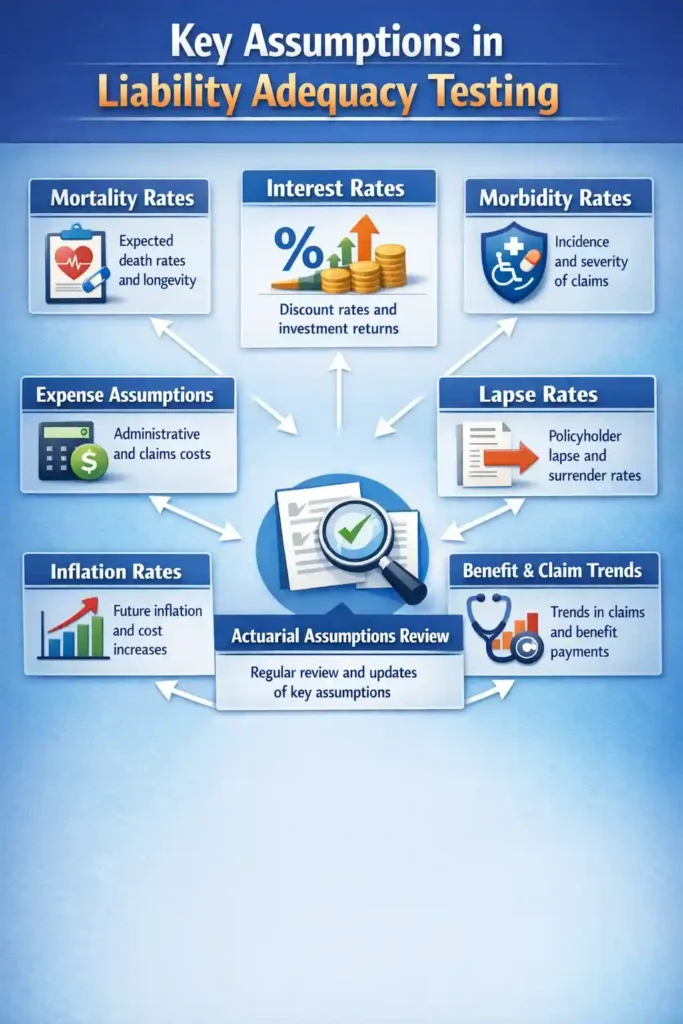
The Liability Adequacy Test (LAT)concept that is based on the use of key assumptions to assess whether a company’s reserves cover future obligations such as claims, benefits and other monetary commitments. These assumptions are the foundation of LAT and might suggestedly affect the results of test. Let us analyze the critical assumptions involved in LAT and how they influence the results of the test.
Influence of Assumptions on LAT
Mortality and Morbidity Rates: LAT uses mortality rates (death rates) and morbidity rates (illness/disability) to project future claim experience on life, health, and disability policies. These estimates are used in forming the assumptions about how many and when claims will happen.
Inflation: Lock in costs today by assuming inflation will increase the price of claims and benefits over time. Ignoring inflation, LAT is capable of grossly underestimating obligations in the future creating insufficient reserves.
Frequency and Severity of Claims: Frequency is how often claims are likely to occur, and severity is the average cost of those claims. LAT predicts how each of these two factors will develop to ensure that reserves reflect the anticipated number and cost of future claims.
Discount Rates: The discount is used to convert future liabilities into today’s value. The higher the discount rate, the lower will be the present value of future obligations and vice versa. It is important to select the appropriate rate for an accurate LAT test.
Lapse Rates: Lapse rates estimate the numbers of policyholders who are anticipated to cancel or not renew their policies. These assumptions impact how many future claims will be reported, as less policies equal less claims.
Impact of Incorrect Assumptions
Applying wrong assumptions results in such destabilisation in LAT, and may cause significant financial loses to the company:
Under-Reserving: When the assumptions are too optimistic (e.g., low claims frequency or severity), LAT may underestimate future obligations and surplus decreases, resulting in indebtedness when claims filed higher than expected.
Over-Reserving: Conversely, however, LAT may lead to overly high reserves if the assumptions are overly conservative (e.g., with respect to claims or mortality rates). This locks in capital that might otherwise be used for growth or other business purposes.
Governance of Assumptions
Controlling for assumptions is extremely important for LAT’s performance. Assumptions should be revisited on a regular bases and adjusted to reflect real-time data or changing market dynamics. Here’s why it’s essential:
Periodic refresh: Assumptions should be refreshed upon completion of each forecasting period to reflect the most recent data patterns or macro-environment.
Reliable Estimations: The estimates should be predicated on proven sources such as industry averages and actuarial reports, so as to arrive at reasonable projections.
Robust Governance: A strong governance process helps in validating each and every assumption properly, minimizing the potential for errors and mistakes.
Benefits of the Liability Adequacy Test (LAT)

Provides for Reserves: With your daily reserve calculation, can you tell if the reserves on hand are appropriate to pay claims, benefits and other obligations in the future?
Early Identification of Financial Risks: Serves as an early warning system, raising the flag on potential reserve shortages before they reach a critical level – permitting early remediation.
Streamlines Compliance: Alignment with accounting standards (including IFRS 17) to prevent discrepancies, and comply with regulatory requirements limiting the risk of penalties.
Enhances Financial Forecasting and Decision Making: Delivers realistic views of financial health to adapt reserves, pricing and underwriting strategy for maximum profitability.
Builds stakeholder Confidence: Proves to policyholders, investors and regulators that it would be able to deliver on its future obligations, thereby creating confidence and trust.
Maintains solvency and liquidity: Actively assesses reserves and makes necessary adjustments in order to achieve long-term stability.
Risk management optimization: It helps in identifying if there are room gaps at risk, so organization can update their risk management approach like pricing and underwriting strategies.
What Happens When Liabilities Are Inadequate?

The Liability Adequacy Test (LAT) indicates that liabilities are inadequate, we begin by isolating the deficiency between updated liability estimates and reserves already established. Management would have to immediately bolster reserves with a higher recorded liability to represent the new cash flow estimates. This transition can result in temporarily lower profitability as additional reserves will reduce reported earnings and may influence capital planning activities. To avoid future such shortfalls, firms usually update pricing plans, underwriting practices and financial projections to bring assumptions in line with true risk exposure.
Accepting lack of reserves exposes you to audit issues, regulatory sanctions, financial restatements and loss of stakeholder confidence. In reality, in the face of LAT deficiencies, most insurers will recalibrate reserve levels and,product pricing I know to shore up solvency and fortify financial strength over time.
LAT’s Impact Beyond Insurance

Application Across Long-Term Liability Models:LAT is pertinent to businesses with long-term financial obligations (e.g., pension plans, service contracts or warranty programs) where future cash commitments must be appropriately estimated and set aside.
Control Over Long-Horizon Financial Risk: With organizations having long liability durations, there’s a concern about whether obligations and reserves match up in the future–there is an exposure to under-provisioning that occurs if you don’t do any LAT testing.
Provides Support for the Right Cash Flow Projections: LAT enhances forecast precision by applying structured estimation on future cash outflow, which allows organizations to have a more reliable plan on capital need.
Response to Global Economic Volatility: Inflation, interest rates and market volatility Influencing favorably or unfavorably a country’s software liability valuation FRG provides a framework with which to re-assess non-performance liability under new economic conditions.
Protection Against Financial Stress Events :LAT supports industry stakeholders to identify early weaknesses in reserves, mitigating exposure to liquidity risk during downturns or at times of surge in claim or payment responsibilities.
Alignment With Evolving Regulatory Standards: LAT aids in complying with the international accounting and financial reporting standards by avoiding that liabilities fall behind current economic assumptions, as well as regulatory expectations.
Strengthening Financial Governance: Regular use of LAT strengthens governance by promoting disciplined liability measurement, documentation and management oversight in industries.
Best Practices for Implementing a Liability Adequacy Test
If you want to obtain reliable and meaningful results from the liability adequacy test (LAT), your organization needs a structured and disciplined approach. Correct implementation of LAT enhances financial security, reinforces risk management as well as ensures compliance with regulations.
Do LAT Regularly Do some LAT regularly :The LAT should be performed at each reporting date to reflect changes in reserves compared with the assumptions, economic environment and claims experience. Frequent testing will allow early spotting of emerging deficits.
Use Reliable and High-Quality Data :LAT work relies heavily on the quality of the input data. Validated historical claims data, current policy details and stabilised expense records should be utilised by companies to provide for realistic future cash flow projections.
Apply Realistic and Well-Governed Assumptions :Assumptions in respect of claims frequency, claims severity, inflation, discount rates, lapse rates and expenses should be based on current experience and market conditions. Assertive governance also helps make sure that assumptions are reviewed, approved and documented correctly.
Conduct Sensitivity and Scenario Analysis: Entities would be required to consider the effect of changes in key assumptions on liabilities. A sensitivity analysis enables you to gauge exposure to economic volatility, interest rate changes and claims uncertainty.
Maintain Clear Documentation: Details of all LAT approaches, assumptions, calculations and judgments must be documented properly. Good records form the basis for audit inspection, regulatory compliance and internal controls.
Embed LAT in Risk Management and Capital Planning: LAT is not something that should work as a standalone. Firms should encompass LAT results in enterprise risk management, pricing, underwriting and capital adequacy planning.
Leverage Strong Actuarial and Financial: Models Accurate actuarial models and easy to maintan systems enhance precision, uniformity and speed. Even more sophisticated mirroring tools allow for stress-testing and long-term projections.
Ensure Strong Management Oversight The obtained LAT results should be evaluated by senior management and governance boards on a regular basis to take corrective actions in time and align the strategies respectively.
Challenges in Performing a Liability Adequacy Test

The performance of the LAT presents several practical and technical challenges that may influence the precision and credibility of the results. These are thorny issues to address, but it’s necessary to make sure that reserves really do translate into future obligations.
Data Quality and Availability Issues :LAT relies on good historical claim information and policy information as well as your expenses. Inaccurate cash flow projections and reserve assessments may result from incomplete, outdated or inconsistent data.
Complexity of Long-Term Liabilities :Long-term products, with multiple benefit patterns or embedded options, add complexity to the model. Future cashflows for such products need to be predicted correctly and these require advanced actuarial methods and systems capable of performing these.
Economic Volatility and Market : Uncertainty Movements in inflation, interest rates and the economy will impact these assumptions (eg discount rates and claims costs). MARKET MOVEMENTS Market dynamics can change suddenly and have a massive impact on LAT results so they must be constantly updated.
Assumption Selection and Judgment Risk :LAT is dependent on a series of assumptions around claims frequency, severity, lapse rates and expenses. When actuarial assumptions are too liberal or rosy, there may be insufficient reserves set aside, and when assumptions are excessively conservative, reserves may be set aside that exceed what is actually needed.
Regulatory and Accounting Changes: Continuing changes in accounting standards and regulatory requirements necessitate ongoing revision of LAT methodologies. Businesses need to move fast in order not to be non-compliant and incur audit-related findings or penalties.
Model Risk and System Limitations : Poor modeling frameworks or obsolete tools can result in poor computation and degraded trust in the LAT results. More complex models can also open the door to implementing and interpreting them wrong, or requiring one to assume more than one wishes.
Resource and Expertise Constraints : The application of LAT needs actuarial and financial expertise. There may be limited resources, no specifically trained personnel or poor governance structures that might render the test ineffective.
Conclusion
The LAT (Liability Adequacy Test) is more than just an accounting and regulatory requirement, it’s also a sophisticated financial control that helps ensure that entities can confidently meet future commitments. By considering whether reserves are in place to fund known liabilities, LAT creates insulation against the under-reserving risks that can jeopardize solvency, profitability and harm stakeholder confidence.
This blog looked at how the LAT works and its underlying assumptions, the impact of insufficient liabilities and the challenges applying it. It also underscored LAT’s increasing significance outside insurance in sectors handling long term commitments amid market gyrations and changing regulatory standards. L at can then be a useful tool in identifying company risk more early, planning for the future more effectively and if used and governed well sends warning signals far into the distance.
FAQ’s
1. What is the Liability Adequacy Test (LAT)?
The Liability Adequacy Test (LAT) is a method used by companies, especially insurers, to ensure their reserves are sufficient to cover future obligations like claims, benefits, and payments.
2. Why is the Liability Adequacy Test important?
The LAT helps companies maintain financial stability, avoid under-reserving risks, comply with accounting standards like IFRS, and build stakeholder confidence.
3. How is the Liability Adequacy Test performed?
The LAT process involves segmenting the portfolio, estimating future cash flows, applying key assumptions, calculating present value, adding risk adjustments, and comparing against reserves.
4. What are the key assumptions in LAT?
Key assumptions include mortality and morbidity rates, inflation, claims frequency and severity, discount rates, and policy lapse rates. These assumptions ensure the LAT reflects realistic financial risk.
5. What happens if liabilities are inadequate in LAT?
If reserves are insufficient, companies must adjust their financial statements, increase reserves, and revise pricing or underwriting strategies to ensure they can meet future obligations.
6. Can LAT be used outside the insurance industry?
Yes, LAT is also useful for any business with long-term obligations, such as pension plans, warranty programs, or service contracts, helping manage future cash flow risks.
7. What are best practices for implementing LAT?
Perform LAT regularly, use reliable historical data, apply well-governed assumptions, conduct sensitivity analysis, maintain clear documentation, and embed LAT in risk management and capital planning.