Software bugs cost the United States economy over $2.41 trillion every year. That figure comes from the Consortium for Information and Software Quality (CISQ) report co-sponsored by Carnegie Mellon’s Software Engineering Institute. It accounts for failed projects, cybersecurity vulnerabilities, technical debt, and operational disruptions caused by defective code.
Development teams across the US face a shared operational problem. Bugs get reported through scattered emails. Spreadsheets lose track of critical issues. Developers waste hours chasing updates instead of writing code. These fragmented workflows cause missed deadlines, duplicated effort, and products that ship with preventable defects.
EndBugFlow addresses this problem at its root. It is a centralized bug-tracking and workflow management platform built specifically for Agile and DevOps environments. The software replaces disconnected tools with a single workspace where bugs are logged, prioritized, assigned, tracked, verified, and analyzed in real time.
This guide answers one question in full detail: how does EndBugFlow software work? It walks through the platform’s core components, the complete bug lifecycle, automation features, collaboration tools, third-party integrations, analytics, regression prevention, and setup process. Every section includes verified data from industry research to show why each feature matters for US-based software development teams.
What Is EndBugFlow Software?
EndBugFlow is a centralized bug-tracking and workflow management platform built for Agile and DevOps teams. It automates issue capture, intelligent prioritization, developer assignment, and resolution verification through a single dashboard that replaces scattered spreadsheets and email threads.
The platform serves three primary user groups. Software developers receive clear bug assignments with full reproduction details. QA testers verify fixes against original defect criteria. Project managers monitor resolution progress and identify bottlenecks across sprints.
EndBugFlow operates as a dedicated issue management system. It is not a general-purpose project management tool like Jira or Asana. Its entire architecture focuses on one objective: moving bugs from discovery to verified resolution with the least friction and the most visibility.
North America holds 49.32% of the global DevOps market share according to Fortune Business Insights. The majority of DevOps teams operate inside the United States. These teams need tools that match the speed of continuous integration and continuous delivery pipelines. EndBugFlow fits that requirement by design.
The platform combines automated bug capture with structured workflows. It connects development, testing, and management functions inside one workspace. Teams that adopt it eliminate the communication gaps that cause bugs to slip through during fast-moving release cycles.
Now that you understand what EndBugFlow is and the scale of the problem it addresses, the next step is understanding the core components that power it.
What Are the Core Components of EndBugFlow?
EndBugFlow operates through five core components: a centralized dashboard for project visibility, an automated bug capture system, a priority engine for severity ranking, a smart assignment algorithm for workload distribution, and a real-time notification system for team alignment.
Centralized Dashboard
The dashboard serves as the nerve center of EndBugFlow. It provides a visual overview of all active projects, currently logged bugs, task assignments, and resolution timelines. Team members see their highest priorities at a glance without switching between tools.
Over 70% of software development teams now use automated bug tracking systems according to market research from the IMRAC Group. The shift away from manual tracking reflects the growing complexity of modern codebases. EndBugFlow’s dashboard supports this transition by displaying real-time data across every project in one view.
The dashboard includes filters for severity level, assigned developer, project name, and status stage. Managers generate filtered views to focus on critical bugs only. Developers filter their personal queue. Each team member uses the same platform with a customized perspective.
Automated Bug Capture
EndBugFlow captures bugs through three channels. Users submit issues through built-in forms with fields for reproduction steps, screenshots, and system specifications. Integrated APIs capture errors from external monitoring tools automatically. Automated error logs detect runtime failures and generate tickets without any human input.
Every captured bug includes critical metadata. The system records the error type, timestamp, browser version, operating system, and the specific module or component affected. This metadata eliminates the back-and-forth that slows down traditional bug reporting.
Priority Engine
Not all bugs carry equal weight. EndBugFlow’s priority engine classifies every issue into four severity tiers: Critical, High, Medium, and Low. The classification considers the technical severity of the defect and its business impact on end users.
This classification matters because 68% of users abandon an application after encountering just two bugs according to industry research from CloudQA. A checkout crash and a broken search bar can cost a SaaS company thousands of paying customers. EndBugFlow ensures Critical bugs surface immediately rather than sitting behind cosmetic issues.
Smart Assignment Algorithm
EndBugFlow recommends the best developer for each bug based on three factors: current workload, technical expertise, and historical resolution speed for similar issues. The recommendation appears on the ticket. Team leads accept it or manually override the assignment.
Clear task ownership prevents a common development problem. When nobody owns a bug, nobody fixes it. The smart assignment system eliminates ambiguity by attaching a name to every issue within seconds of capture.
Real-Time Notification System
The notification system keeps every team member informed without requiring constant dashboard checks. EndBugFlow delivers alerts through in-app notifications, email, and integrations with messaging platforms like Slack and Microsoft Teams.
Teams configure notification rules to match their workflow. A QA lead receives alerts only for bugs entering the Review stage. A CTO receives alerts only for Critical severity issues. Customization prevents notification fatigue while ensuring the right people see the right updates.
With these five components working together, every bug that enters EndBugFlow follows a structured path from discovery to resolution. Here is how that lifecycle works step by step.
How Does the Bug Lifecycle Work in EndBugFlow?
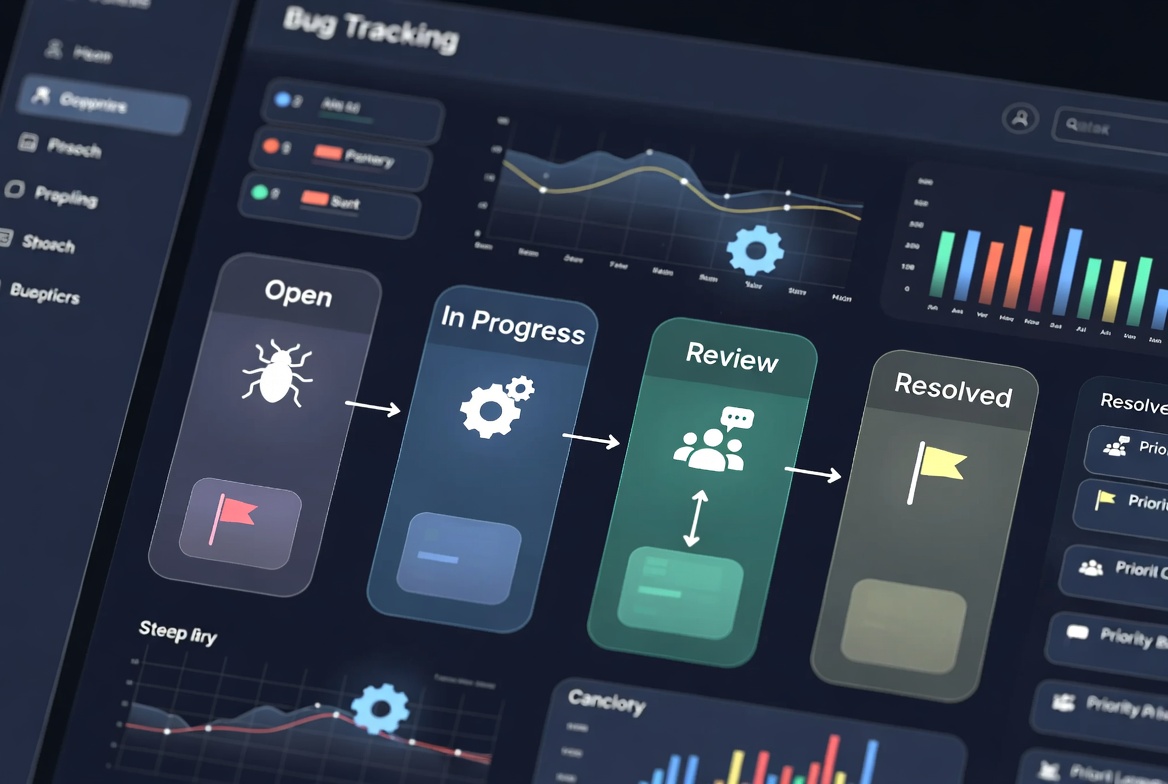
Every bug in EndBugFlow moves through five structured stages: Open, In Progress, Review, Resolved, and Closed. The platform tracks each transition automatically, records status changes with timestamps, and ensures no issue stalls without visibility or accountability.
Understanding this lifecycle is essential. Fixing a production bug costs 100 times more than catching it during the design phase. That cost escalation principle comes from research by the IBM Systems Sciences Institute. EndBugFlow’s structured lifecycle catches bugs earlier and tracks every step of remediation.
Stage 1: Open
A bug enters the system through automated capture or manual submission. The platform records all metadata instantly. The priority engine assigns a severity tier. The smart assignment algorithm recommends a developer. The ticket is live and visible on the dashboard.
Stage 2: In Progress
The assigned developer accepts the ticket and begins work. The status shifts to In Progress. Team members view the active assignment on the dashboard. Collaborators add comments, upload screenshots, and tag colleagues for input without leaving the ticket thread.
Stage 3: Review
The developer marks the bug as fixed. The status changes to Review. Peers or technical leads inspect the solution. This review step catches incomplete fixes before the issue reaches QA. It acts as a quality gate within the development team.
Stage 4: Resolved
A QA tester verifies the fix against the original reproduction steps. The tester checks whether the defect is genuinely eliminated. If the fix fails verification, the bug reopens and returns to In Progress with failure notes attached. If it passes, the ticket moves to the final stage.
Stage 5: Closed
The verified bug receives Closed status. EndBugFlow archives the complete resolution history. This archive includes every comment, status change, file attachment, and timestamp. The data feeds into the analytics module for pattern detection and future prevention.
This structured lifecycle works efficiently because EndBugFlow automates the repetitive steps that typically slow development teams down. Here is how automation drives each stage.
How Does EndBugFlow Automate Bug Tracking?
EndBugFlow automates bug tracking through three mechanisms: automated issue capture from error logs and API integrations, algorithm-driven priority assignment based on severity and impact, and real-time status updates that eliminate manual follow-ups and reduce developer time spent on administrative tasks.
US developers spend 20% of their working time fixing bugs. That translates to roughly $20,000 per developer per year in salary costs alone, based on data reported by VentureBeat. A significant portion of that time goes toward administrative overhead: filing tickets, chasing status updates, and triaging reports. EndBugFlow’s automation targets these exact bottlenecks.
Automated Issue Capture
EndBugFlow monitors connected systems and captures errors without manual input. When a build fails in a CI/CD pipeline, the platform generates a ticket automatically. When an API returns an unexpected error, the system logs it with full context. Teams receive structured bug reports instead of vague error messages.
Algorithm-Driven Prioritization
The rules engine evaluates every incoming bug against configurable criteria. It checks the defect severity, the number of affected users, and whether the issue impacts a business-critical function. Teams set custom rules per project. A payment gateway bug in an e-commerce application might always receive Critical status automatically.
Automated Status Updates
EndBugFlow triggers status changes based on developer actions. When a developer pushes a commit linked to a bug ticket ID, the status moves to Review automatically. When a QA tester marks verification as passed, the status advances to Resolved. These triggers eliminate the manual updates that consume attention during every sprint.
Workload-Balanced Auto-Assignment
The assignment algorithm distributes incoming bugs across available developers based on current task load. It prevents situations where one developer handles 15 tickets while another handles three. When recommended developers are unavailable, fallback rules route the bug to the next qualified team member.
Automation handles the mechanical side of bug management. But effective resolution also requires real-time collaboration between developers, testers, and managers. EndBugFlow’s collaboration layer addresses this need.
How Do Teams Collaborate Inside EndBugFlow?
EndBugFlow enables team collaboration through in-thread commenting on each bug ticket, @mention tagging for specific team members, file and screenshot attachments, and activity logs that record every action taken on an issue from creation to closure.
A total of 99% of organizations that adopted DevOps practices reported a beneficial impact according to the 2024 DORA research. That positive outcome depends on clear, real-time communication between developers and operations teams. EndBugFlow builds this communication directly into the bug resolution workflow.
In-Thread Comments
Every bug ticket contains its own discussion thread. Developers, testers, and managers communicate within the context of the specific issue. Questions about reproduction steps, proposed solutions, and testing results stay attached to the relevant ticket. This eliminates cross-channel confusion.
@Mention Tagging
Team members tag specific colleagues using @mentions inside ticket threads. The tagged person receives a notification immediately. A QA tester who discovers a regression tags the original developer directly instead of posting a general message and waiting.
File and Screenshot Attachments
EndBugFlow supports direct file uploads on every ticket. Teams attach screenshots, screen recordings, log files, and reproduction scripts. A developer who receives a bug ticket with a 30-second screen recording reproduces the issue faster than one who receives a two-paragraph written description.
Complete Activity Logs
Every action on a bug ticket is logged with a timestamp. Status changes, comment additions, reassignments, file uploads, and priority adjustments appear in a chronological activity log. This creates a full audit trail for sprint retrospectives, accountability reviews, and compliance documentation.
Collaboration keeps teams aligned during active bug resolution. But EndBugFlow also connects to existing development tools so teams do not need to abandon their established workflows.
What Tools and Platforms Does EndBugFlow Integrate With?
EndBugFlow integrates with version control systems like Git, CI/CD pipelines such as Jenkins and GitHub Actions, messaging platforms including Slack and Microsoft Teams, and project management tools through APIs and webhooks for seamless data exchange.
Version Control Integration
EndBugFlow links directly to Git repositories. When a developer pushes a commit referencing a bug ticket ID, the platform associates the commit with the ticket automatically. The ticket updates its status and displays the linked code change. QA testers gain direct visibility into what code changed to address the defect.
CI/CD Pipeline Connection
Failed builds in Jenkins, GitHub Actions, or CircleCI generate bug tickets automatically. The pipeline sends failure details to EndBugFlow through a webhook. The platform creates a ticket with the build log, failure reason, and affected component. This removes the delay between a failed build and a filed bug report.
Teams using CI/CD deliver software 2.5 times faster than those using traditional methods. That benchmark comes from the DORA State of DevOps research. EndBugFlow’s CI/CD integration amplifies this speed advantage by connecting the deployment pipeline directly to the bug tracking system.
Messaging Platform Integration
EndBugFlow sends real-time notifications to Slack channels and Microsoft Teams conversations. Teams configure which bug events trigger messages. A new Critical bug posts to a dedicated incident channel. A status change to Resolved notifies only the assigned tester.
API and Webhook Support
Custom integrations extend EndBugFlow to proprietary tools. The API documentation provides endpoints for creating, reading, updating, and closing bug tickets programmatically. Webhooks allow external systems to trigger actions inside EndBugFlow based on events like deployment completions or test suite results.
These integrations feed data into EndBugFlow continuously. The platform converts that raw data into actionable insights through its analytics and reporting module.
How Does EndBugFlow’s Analytics and Reporting Work?
EndBugFlow’s analytics module tracks resolution time, bug recurrence rate, developer workload distribution, and sprint velocity. It generates visual reports that identify bottlenecks, recurring defect patterns, and team performance trends to support data-driven project management decisions.
One hour of system downtime costs enterprises $300,000 on average according to a 2023 industry study by Aspire Systems. Analytics help teams spot patterns before individual bugs escalate into system-wide outages.
Key Metrics Tracked
The analytics module measures five core metrics. Mean Time to Resolve (MTTR) tracks how long bugs take from Open to Closed. Recurrence rate measures how often resolved bugs reopen. Developer workload distribution shows task balance across the team. Severity distribution reveals the ratio of cosmetic to critical bugs. Sprint-level bug trends track quality improvements over time.
Bottleneck Detection
The platform highlights bugs that stall in specific lifecycle stages. A bug stuck in Review for 48 hours triggers a visual alert. A developer whose tickets take three times the team average to resolve appears in workload reports. These signals help managers intervene before silent delays compound into missed deadlines.
Recurrence Reports
EndBugFlow flags bugs that reopen after being marked Resolved. A bug that reappears three times across sprints usually points to an architectural flaw rather than a simple code error. The recurrence report helps teams prioritize root cause investigation over repeated surface-level patches.
Custom Report Generation
Teams export reports for sprint retrospectives, stakeholder presentations, and compliance audits. Reports include visual charts, data tables, and historical comparisons. Engineering directors use these reports to justify resource requests. QA leads use them to demonstrate testing coverage improvements across release cycles.
Analytics reveal where problems occur repeatedly. But preventing bugs from recurring requires a dedicated verification and regression prevention process. That is the final critical step in EndBugFlow’s workflow.
How Does EndBugFlow Prevent Bugs From Recurring?
EndBugFlow prevents bug recurrence through mandatory QA verification before closure, automated regression tracking that flags previously resolved issues that reappear, historical resolution data that informs root cause analysis, and pattern detection across the full defect database.
A total of 85% of website bugs are detected by end users rather than during internal testing. That statistic comes from IBM research highlighted in developer community reports. EndBugFlow’s verification and prevention mechanisms reduce this escape rate by requiring structured QA sign-off before any bug reaches Closed status.
Mandatory QA Verification Gate
No bug moves to Closed without QA sign-off. A tester validates the fix against original reproduction steps. If the fix fails, the ticket reopens automatically and returns to In Progress with failure notes attached. This gate prevents premature closure of bugs that appear fixed in one environment but fail in another.
Automated Regression Tracking
EndBugFlow monitors for previously resolved bugs reappearing in new builds. When a closed bug’s symptoms match a new ticket’s description, the platform flags the connection. This catches regressions introduced by adjacent code changes and speeds up diagnosis by linking new defects to historical fixes.
Root Cause Knowledge Base
Every resolved bug contributes data to a searchable knowledge base. The database stores what caused each bug, how the team fixed it, and how long resolution took. New developers search this knowledge base before starting work on unfamiliar defects. The result is faster onboarding and fewer repeated investigation cycles.
Pattern Detection Across Sprints
Analytics identify recurring defect clusters by component, developer, or sprint period. If one module generates 40% of all Critical bugs, the data surfaces that pattern. Engineering leads use these insights to schedule targeted code reviews, refactoring sprints, or architecture audits that address systemic weaknesses.
With these prevention mechanisms in place, US-based development teams gain specific operational advantages. Here is why EndBugFlow adoption is growing across the American software industry.
Why Do US Software Teams Use EndBugFlow?
US software teams use EndBugFlow because it reduces bug resolution time, lowers development costs, improves release stability, and aligns with the Agile and DevOps methodologies that 90% of Fortune 500 companies and 74% of all organizations have adopted.
The bug tracking software market is projected to reach $822.10 million by 2033 at a 7.88% compound annual growth rate according to the IMRAC Group market analysis. This growth reflects increasing recognition that structured bug management is a baseline operational requirement for competitive software companies.
Reduced Bug Resolution Time
Centralized tracking eliminates time lost when bug reports scatter across emails, chat messages, and individual spreadsheets. Smart assignment routes each bug to the right developer within seconds. Automated status updates remove the need for daily check-in meetings about ticket progress.
Lower Development Costs
Automation reduces the administrative overhead that consumes 20% of developer time. Earlier detection through structured workflows reduces the cost multiplier documented by IBM: a bug caught in design costs $100 to fix while the same bug in production costs $10,000. EndBugFlow’s lifecycle catches defects at earlier stages.
Improved Release Stability
The QA verification gate and regression tracking ensure fewer defects escape into production. User retention matters because acquiring a new customer costs five to seven times more than retaining an existing one according to customer retention research. Stable releases protect revenue directly.
Agile and DevOps Alignment
EndBugFlow fits naturally into sprint-based development. Teams using Scrum integrate it into sprint planning and retrospectives. Kanban teams use the dashboard as a visual board for bug workflow management.
Fortune 500 companies show approximately 90% DevOps adoption rates according to analysis from DevOpsBay. These organizations require tools matching their operational maturity. EndBugFlow meets that standard with enterprise-grade automation, integration, and reporting.
Understanding these benefits naturally raises the practical question of how teams actually set up and start using EndBugFlow.
How Do You Set Up EndBugFlow for Your Team?
Setting up EndBugFlow requires four steps: creating a project workspace, configuring team roles and permissions, connecting existing development tools through APIs, and customizing workflow stages, priority rules, and notification preferences to match the team’s established methodology.
Step 1: Create a Project Workspace
Start by creating a dedicated workspace inside EndBugFlow. Define the project name, set ticket naming conventions, and establish the bug taxonomy. The taxonomy includes categories (frontend, backend, mobile, API), components (checkout, search, dashboard), and custom tags matching your codebase structure.
Step 2: Configure Team Roles and Permissions
Add every team member to the workspace. Assign roles based on function: developer, tester, manager, or admin. Set permissions so developers create and update tickets. Testers verify and reopen tickets. Managers reassign, adjust priority, and access analytics. Admins modify workflow settings and integration configurations.
Step 3: Connect Your Development Tools
Navigate to the integration panel and connect your version control system. Link your Git repository for automatic commit-to-bug associations. Connect your CI/CD pipeline (Jenkins, GitHub Actions, or CircleCI) to enable automated ticket creation from failed builds. Add your messaging platform for real-time notifications.
Step 4: Customize Workflows and Rules
Review the default lifecycle stages. Add or rename stages if your team uses a different process. Configure priority rules so the system assigns Critical status to specific conditions automatically. Set notification triggers so each role receives only relevant alerts.
EndBugFlow adapts to existing methodologies. Teams running Scrum sprints, Kanban boards, or hybrid approaches configure the platform to match their process. Most teams complete full setup and begin logging bugs within one working day.
Frequently Asked Questions
Is EndBugFlow suitable for small development teams?
Yes. EndBugFlow scales from small teams with five to ten developers up to enterprise organizations. Workspace configuration adapts to team size without additional infrastructure or premium upgrades.
Does EndBugFlow support Agile and Scrum workflows?
Yes. EndBugFlow supports Agile, Scrum, Kanban, and hybrid workflows. Teams customize status stages, sprint integration, and backlog management to match their methodology.
Can EndBugFlow integrate with GitHub and GitLab?
Yes. EndBugFlow integrates with GitHub, GitLab, and Bitbucket through APIs and webhooks for automated commit-to-bug linking and status synchronization.
How does EndBugFlow handle duplicate bug reports?
EndBugFlow uses intelligent categorization to detect potential duplicates. The system compares error type, affected component, and reproduction steps against existing tickets before creating a new entry.
Does EndBugFlow provide mobile access?
Yes. EndBugFlow offers mobile-responsive access. Developers and managers review bug status, respond to comments, and receive critical alerts from smartphones and tablets during off-site meetings and after-hours incidents.
What security features does EndBugFlow include?
EndBugFlow includes role-based access control, encrypted data transmission, audit logging, and granular permission configuration. These features protect sensitive project data and support compliance requirements.
Can EndBugFlow generate compliance reports?
Yes. The analytics module exports custom reports for sprint retrospectives, stakeholder updates, and regulatory compliance documentation with full audit trails and timestamped records.
How does EndBugFlow compare to Jira for bug tracking?
EndBugFlow is a dedicated bug-tracking platform focused on automated capture, smart assignment, and QA verification. Jira is a broader project management tool covering task management, roadmapping, and agile boards. EndBugFlow prioritizes streamlined bug workflow over general-purpose task management. Teams needing specialized bug tracking choose EndBugFlow for its focused workflow.
Does EndBugFlow support custom fields?
Yes. Teams add custom fields, tags, and categories to bug tickets. Examples include customer-reported flag, affected region, estimated revenue impact, and release version.
What is the learning curve for EndBugFlow?
EndBugFlow is designed for rapid onboarding. Most teams configure their workspace and begin logging bugs within one working day. The interface follows standard bug-tracking conventions familiar to development teams