Imagine you are a fresh graduate who has spent three years learning graphic design, completing freelance projects, and building real experience. You apply for a job, and the recruiter asks for your portfolio link. You do not have one. You open your laptop, search for website builders, and immediately feel overwhelmed by templates, hosting plans, and technical settings.
This is one of the most common frustrations for students, job seekers, and freelancers today. They have real skills, real work, and real results, but they have no professional way to show them online. The good news is that you do not need to know a single line of code to build a strong, professional portfolio. The process has become much simpler, and with the right approach, you can have a polished online presence ready within hours.
In this guide, you will learn exactly how to convert your skills into an online portfolio, what to include, how to present your work, and how platforms like CEVEW make the entire process easy for anyone, regardless of technical background.
Why Does an Online Portfolio Matter More Than a Traditional CV?
A traditional CV tells an employer what you can do. A portfolio shows them. That is a significant difference, especially in competitive job markets where hundreds of applicants send in
similar-looking resumes.
When a recruiter reviews your portfolio, they can see your actual work, your thought process, your results, and your professional presentation. This builds trust in a way that a list of bullet points simply cannot. For freelancers especially, a portfolio is often the first thing a client looks at before deciding whether to hire.
An online portfolio also stays accessible around the clock. A hiring manager in a different time zone can review your work at midnight without waiting for you to send attachments. For students applying for internships or part-time roles, a portfolio link in an email makes a strong impression and shows initiative.
The challenge has always been that building a website from scratch requires technical knowledge most people do not have. That barrier no longer exists.
What Does It Mean to Convert Your Skills into an Online Portfolio?
Converting your skills into an online portfolio means taking everything you know, everything you have done, and everything you have learned, and presenting it in a structured, visual, and shareable format online.
This is not just about listing your skills on a page. It is about telling a professional story. Your portfolio should answer three questions for any visitor: Who are you? What can you do? What have you already done?
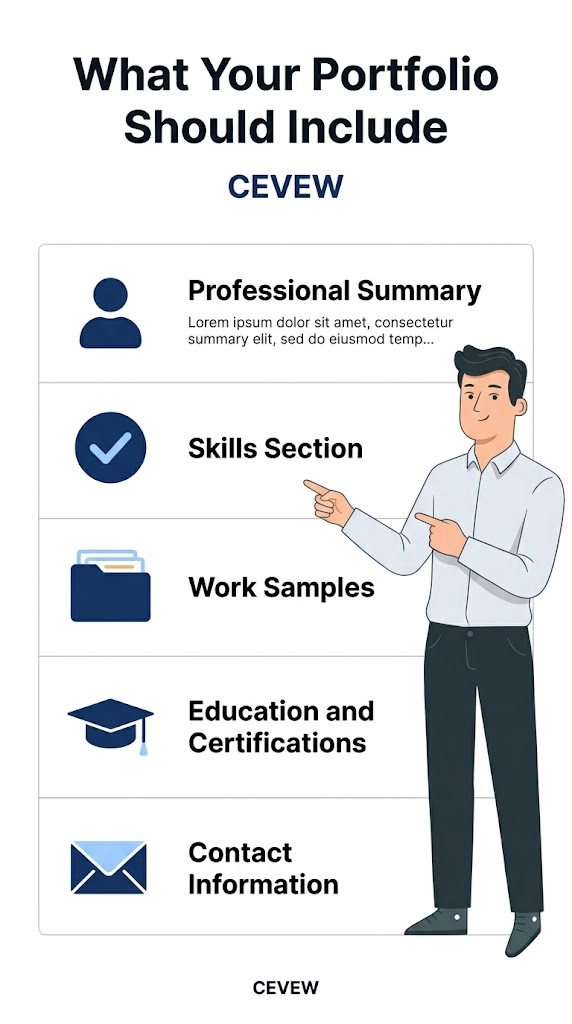
A well-structured portfolio typically includes the following sections.
Professional summary: A short paragraph that introduces you, your area of expertise, and what kind of work you are looking for. This is your opening pitch.
Skills section: A clear list of your technical and soft skills. Be specific. Instead of writing “communication skills,” write “client presentations, written reports, and team coordination.”
Work samples or projects: This is the heart of your portfolio. Include real examples of your work, whether those are design files, written pieces, code screenshots, photography, or project results.
Education and certifications: Formal qualifications still matter. List your degrees, diplomas, and any relevant certifications you have completed.
Contact information: Make it easy for anyone to reach you. A portfolio with no contact details defeats its own purpose.
How Can You Build a Portfolio Without Any Coding Knowledge?
The idea that you need to code to have a professional online presence is outdated. Several tools and services allow you to build your skills portfolio online without touching a single line of HTML or CSS.
Use a No-Code Portfolio Platform
No-code platforms give you pre-designed templates and drag-and-drop tools. You simply fill in your information, upload your work, and publish. Platforms like these are designed for people who want results without technical complexity.
CEVEW takes this even further. Instead of asking you to design anything yourself, you simply share your details, and the platform builds a professional CV and portfolio link for you. This is ideal for students and early-career professionals who want a polished result without spending hours on design decisions.
Organize Your Information Before You Start
Before you open any platform, spend fifteen minutes gathering everything you need. Write down your work history, list your skills, collect samples of your best work, and note any achievements or results you are proud of. Having this ready makes the process much faster and ensures your portfolio is complete from the start.
Choose a Clean, Professional Format
A cluttered portfolio creates a poor first impression. Stick to a simple structure. Use clear headings, consistent fonts, and enough white space to make your content easy to read. You do not need creative design flair to make a good portfolio. Clarity and professionalism are what matter most.
What Should a Beginner Include in Their First Portfolio?
Many people hesitate to create a portfolio because they feel they do not have enough experience. This is a common mistake. Every beginner has something to show, even if it is not paid professional work.
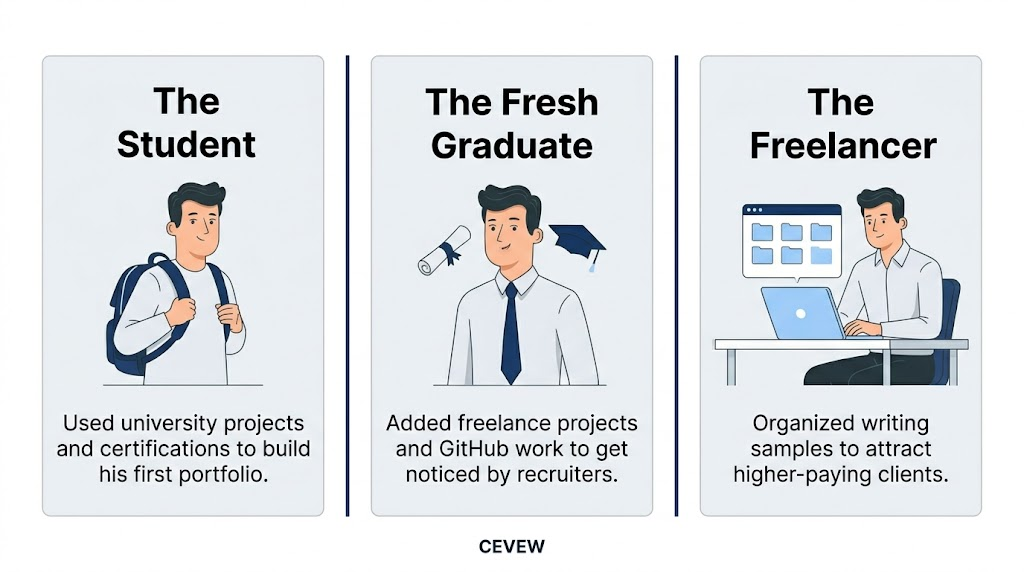
Example One: The Student With No Work Experience
Consider a final-year business student named Sara. She has never held a full-time job, but she has completed three university projects, helped organize a campus event, and taken an online course in digital marketing.
Sara can build a strong portfolio by including her university project reports with a brief description of her role and results, a section on her digital marketing certification with a link to the certificate, a short summary of the campus event she helped organize, and a list of tools she knows, such as Microsoft Excel, Canva, and Google Analytics.
This portfolio does not look empty. It looks like a capable, motivated young professional who has been building skills while studying. Sara can use CEVEW’s student CV portfolio service to have this presented professionally without doing any design work herself.
Example Two: The Fresh Graduate Applying for Their First Job
Ahmad graduated six months ago with a degree in information technology. He has done two freelance web projects for small local businesses, and he has a GitHub account with personal projects. He has been sending his CV but getting no responses.
The problem is not his skills. The problem is that his CV does not show his work. When Ahmad builds a portfolio and adds it as a link to his job applications, recruiters can instantly see working project examples, his GitHub contributions, a description of the client work he completed, and the technologies he used in each project.
His response rate improves because now employers are not just reading about what he can do. They are seeing it directly.
Example Three: The Freelancer Building Long-Term Credibility
Fatima is a freelance content writer with two years of experience. She gets clients through referrals, but she wants to start attracting higher-paying clients from international platforms. She has no portfolio website, just a folder of Word documents on her laptop.
By organizing her best articles, client testimonials, and niche topics into a professional portfolio, Fatima can position herself as an expert in her field. She can include writing samples with client names or anonymized details, a short bio that explains her specialization, the industries she has written for, such as health, finance, and technology, and her contact details and rates.
Fatima can use a portfolio website design service to have this done professionally while she focuses on client work.
What Are the Most Common Mistakes People Make When Creating a Portfolio?
Even with good tools available, many people create portfolios that do not work in their favor. Understanding these mistakes helps you avoid them.
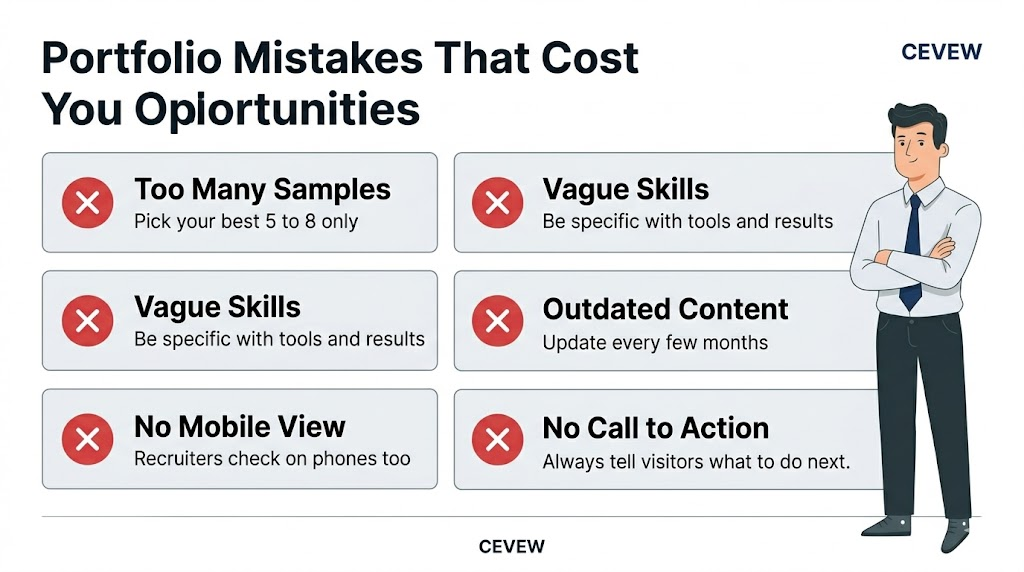
Including too much: A portfolio is not a archive of everything you have ever done. Choose your best five to eight work samples. Quality matters more than quantity. A recruiter who sees ten mediocre samples will remember the weakest ones.
Writing vague skill descriptions: Saying you have “strong communication skills” tells an employer nothing they cannot read on a thousand other CVs. Describe specific situations, tools, or results. For example, “managed client communication for five active projects simultaneously using Trello and Slack” is far more convincing.
Using a complicated layout: If your portfolio is hard to navigate, visitors will leave. Keep navigation simple. Use clear headings, make your contact information visible, and ensure your portfolio loads quickly on mobile devices.
Ignoring updates: A portfolio from three years ago that has not been updated signals to employers that you have not been active. Review your portfolio every few months and add recent work, updated skills, or new certifications.
Forgetting a call to action: Every portfolio should tell the visitor what to do next. Whether that is emailing you, downloading your CV, or filling out a contact form, make the next step clear.
How Does CEVEW Help You Convert Your Skills Into a Professional Portfolio?
CEVEW is built specifically for people who want a professional online presence without the complexity of building one themselves. You share your details, and CEVEW turns them into a professional CV and portfolio link that you can send to employers, share on LinkedIn, or include in job applications.
This approach removes every technical barrier. You do not need to choose a template, configure hosting, manage a domain, or learn any design tools. Everything is handled for you.
For students and fresh graduates, CEVEW provides a structured way to present academic projects and early-career experience in a format that looks credible and professional. For freelancers, it creates a shareable link that can be sent to potential clients instantly. For professionals looking to advance their careers, it provides a polished digital presence that complements their CV.
If your educational institution wants to offer portfolio support to its students, CEVEW also provides an institute portfolio management service that helps schools and universities manage student profiles at scale.
What Are the Best Practices for Showcasing Skills in a Portfolio?
Building a portfolio is one thing. Making it effective is another. These practices help ensure your portfolio actually works for your career.
Lead with your strongest work. Visitors rarely scroll through an entire portfolio. Place your best and most relevant work at the top so it is the first thing people see.
Write clear project descriptions. For each work sample, include a short explanation of what the project was, what your specific role involved, and what the outcome or result was. This
context helps employers understand not just what you made, but how you think and what value you deliver.
Tailor your portfolio to your target audience. A portfolio you use when applying for a marketing role should emphasize different work than one you send to a design agency. Keep core samples consistent, but adjust your summary and highlighted skills based on the opportunity.
Add testimonials or references when possible. Even a short quote from a professor, supervisor, or satisfied client adds significant credibility. Social proof from others is far more persuasive than self-description.
Make your portfolio mobile-friendly. Many recruiters review candidates on their phones. A portfolio that looks great on desktop but breaks on mobile is losing you opportunities. Platforms like CEVEW handle this automatically.
Frequently Asked Questions
Can I create an online portfolio if I have no work experience at all?
Yes, absolutely. A portfolio does not require paid work experience. You can include university or school projects, personal projects you have worked on independently, online courses and certifications you have completed, and any volunteer or community work. The goal is to show your skills and your ability to apply them, not just your employment history.
How long does it take to build a portfolio without coding?
If you use a service like CEVEW, the process can take as little as a few hours once you have gathered your information. The time-consuming part is collecting your work samples and writing clear descriptions. The actual building and publishing can be very fast with the right platform.
Do I need to pay for a domain or hosting to have an online portfolio?
Not necessarily. Many portfolio services provide hosted links as part of their offering, meaning you do not need to purchase a separate domain or manage any hosting. CEVEW provides a portfolio link that you can use immediately without any additional technical setup or cost.
Conclusion
The gap between having skills and showing them professionally no longer needs to be a barrier. Whether you are a student about to enter the job market, a recent graduate trying to stand out, or a freelancer looking to attract better clients, a well-built online portfolio changes how people perceive your professional value.
The key is to stop waiting until you feel ready and start with what you have. Gather your best work, write clear descriptions, and present it in a format that is easy to navigate and professional in appearance. You do not need to code, design, or manage a website to do this well.
CEVEW is designed to make exactly this process simple. You share your details, and a professional CV and portfolio link is built for you. If you are ready to take the next step in your career, start now and let your skills speak for themselves.