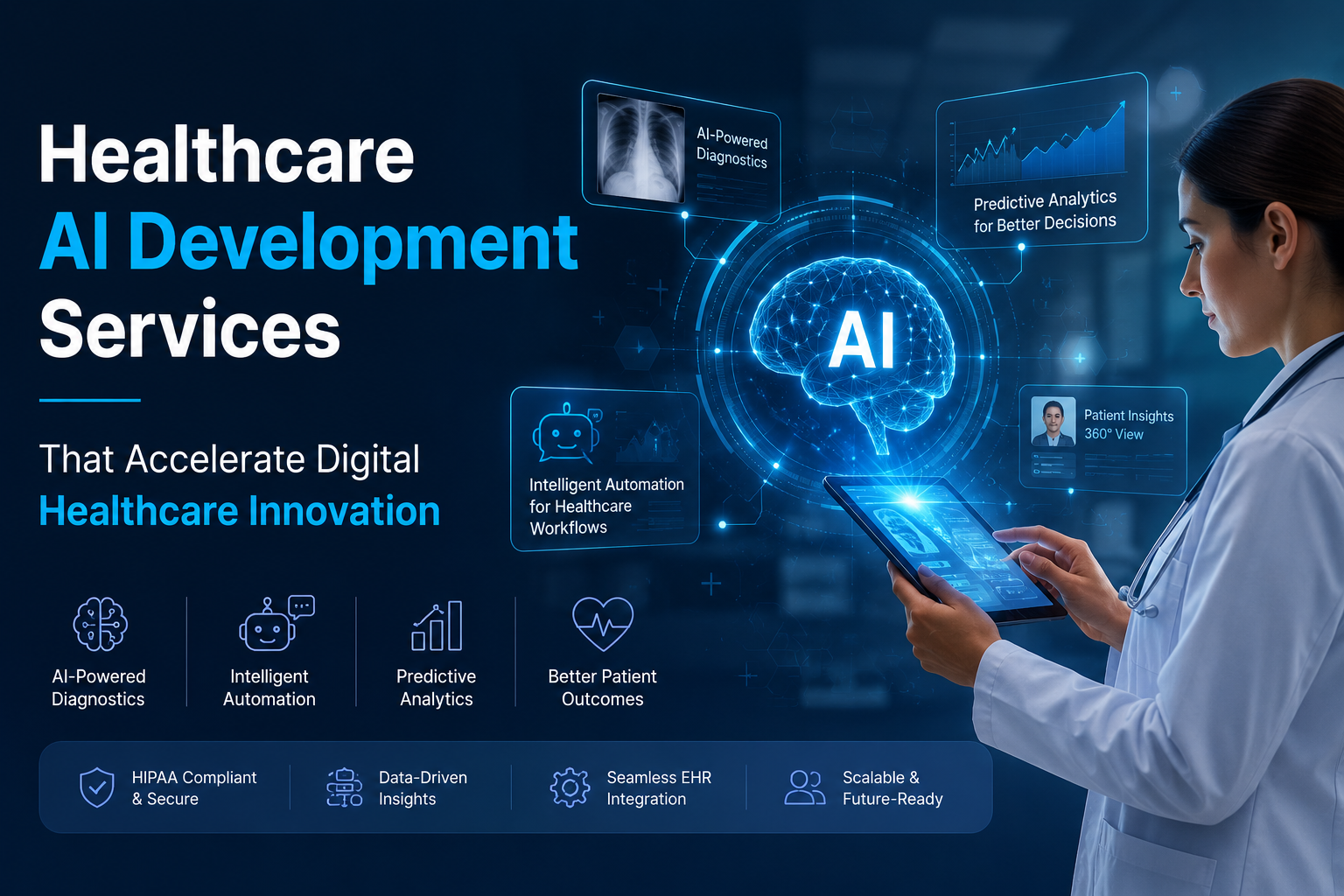
The healthcare industry is undergoing one of the most significant technological shifts in its history — and artificial intelligence is at the center of it. From intelligent diagnostics to automated revenue cycles, AI is no longer a futuristic concept; it is an operational imperative. Yet many healthcare organizations still struggle to translate AI’s promise into real-world outcomes.
That gap is where expert healthcare AI development services become critical.
Whether you are a health system modernizing legacy workflows, a payer streamlining claims processing, or a healthtech startup building the next breakthrough product, partnering with a qualified healthcare AI development company can determine whether your AI investment delivers value or stalls in a proof-of-concept phase.
This guide covers what to look for in healthcare AI development services, key capabilities, proven use cases, measurable benefits, and why Azilen stands out as a trusted development partner for healthcare organizations across the United States.
Why Healthcare Organizations Are Investing in AI
The data tells a compelling story. The global healthcare AI market is projected to reach $187.95 billion by 2030, growing at a compound annual growth rate of over 37% (Grand View Research, 2024). In the United States, nearly 75% of health executives report that AI adoption is a top strategic priority for the next three years.
The drivers are structural, not just technological:
- Staff shortages: The U.S. faces a projected shortfall of up to 124,000 physicians by 2034 (AAMC). AI helps extend clinical capacity without adding headcount.
- Rising costs: Administrative waste accounts for nearly $265 billion annually in U.S. healthcare (JAMA). Automation and AI can recapture significant portions of that.
- Patient expectations: Post-pandemic patients expect digital-first, personalized care. AI enables that experience at scale.
- Regulatory complexity: AI-powered compliance monitoring helps organizations stay current with evolving CMS and HIPAA requirements.
- Data volume: Healthcare generates nearly 30% of the world’s data. Without AI, that data remains largely unexploited.
Organizations that invest in healthcare AI development services today are building a durable competitive advantage — one that compounds over time as models learn, improve, and integrate deeper into clinical and operational workflows.
Key Healthcare AI Development Services
A full-spectrum healthcare AI development company delivers across the entire lifecycle of an AI solution — from strategy to deployment to continuous optimization. Here is what that looks like in practice:
AI Strategy and Consulting Before writing a line of code, healthcare organizations need clarity on where AI creates the most value. Strategy engagements assess existing data assets, infrastructure readiness, regulatory constraints, and competitive positioning to define a phased AI roadmap with measurable ROI milestones.
Custom AI Solution Development Off-the-shelf AI tools rarely fit the nuanced workflows of healthcare. Custom development means building models trained on your patient population, integrated with your EHR and claims systems, and designed around your compliance environment — whether that is HIPAA, HITRUST, or 21 CFR Part 11.
Predictive Analytics Predictive models turn historical clinical and operational data into forward-looking intelligence. Use cases include patient readmission risk, chronic disease progression, supply chain demand forecasting, and population health management. These models help care teams intervene earlier and allocate resources more effectively.
Medical Imaging AI Computer vision models can analyze X-rays, MRIs, CT scans, and pathology slides with accuracy that rivals — and in some narrow tasks, exceeds — specialist review. Imaging AI accelerates diagnosis, flags anomalies for priority review, and reduces diagnostic variability across care sites.
Generative AI Applications Large language models are reshaping clinical documentation, patient communication, and knowledge retrieval. Generative AI can draft clinical notes from ambient conversations, answer patient questions in real time, summarize prior authorizations, and surface relevant clinical literature at the point of care.
Clinical Decision Support Systems (CDSS) AI-powered CDSS integrates into physician workflows to flag drug interactions, recommend evidence-based treatment protocols, alert on deteriorating patient vitals, and reduce diagnostic error. When well-designed, CDSS reduces cognitive load rather than adding to it.
Intelligent Automation Robotic process automation combined with AI handles high-volume, rules-based tasks: eligibility verification, claims scrubbing, appointment scheduling, prior authorization, and coding review. This frees clinical and administrative staff for higher-value work.
Top Use Cases of AI in Healthcare
Diagnostics and Early Detection AI diagnostic tools achieve sensitivity rates exceeding 90% for conditions such as diabetic retinopathy, early-stage lung cancer, and skin lesions. Early detection directly translates to better patient outcomes and lower treatment costs.
Patient Engagement and Virtual Care AI-powered chatbots and virtual health assistants handle appointment scheduling, medication reminders, post-discharge follow-up, and symptom triage. Health systems using AI engagement tools report 20–35% reductions in no-show rates and measurable improvements in care plan adherence.
Remote Patient Monitoring (RPM) Wearable and IoT-connected devices generate continuous patient data. AI analyzes that data stream, identifies clinically significant trends, and alerts care teams before a condition escalates. For chronic disease management, RPM with AI has demonstrated a 30% reduction in hospital readmissions.
Drug Discovery and Clinical Trials AI accelerates target identification, compound screening, and patient recruitment for clinical trials. What traditionally took years can now be compressed into months, reducing the cost of bringing new therapies to market.
Administrative Automation From prior authorizations to discharge summaries to billing code assignment, AI handles documentation-heavy tasks with greater speed and accuracy than manual processes. Health systems report staff time savings of 15–25% in administrative departments following AI automation deployment.
Revenue Cycle Optimization AI models trained on claims data identify denial patterns, flag likely-to-deny claims before submission, automate underpayment detection, and accelerate the accounts receivable cycle. Organizations leveraging AI in revenue cycle management report 20–40% reductions in claim denial rates.
Benefits of Healthcare AI Development Services
| Benefit Area | Impact |
|---|---|
| Better Patient Outcomes | Earlier detection, personalized care plans, and proactive intervention improve clinical results |
| Reduced Operational Costs | Automation of administrative tasks cuts overhead by 15–30% in target departments |
| Faster Clinical Decisions | AI-assisted diagnostics and CDSS reduce time-to-diagnosis and time-to-treatment |
| Improved Efficiency | Workflows that previously required multiple manual steps are streamlined into automated pipelines |
| Enhanced Patient Experience | Personalized communication, faster responses, and proactive outreach improve satisfaction and loyalty |
Traditional Healthcare Processes vs. AI-Powered Healthcare Processes
| Process Area | Traditional Approach | AI-Powered Approach |
|---|---|---|
| Diagnosis | Physician review of records and test results; time-intensive | AI flags anomalies, surfaces risk scores; physician focuses on decision |
| Claims Processing | Manual review, high error rate, slow cycle times | Automated coding, real-time denial prediction, faster reimbursement |
| Patient Monitoring | Periodic check-ins, delayed escalation | Continuous IoT-based monitoring, real-time alerting |
| Drug Interaction Checks | Pharmacist review, possible gaps at handoff | AI scans full medication history at point of prescribing |
| Appointment Scheduling | Phone-based, high no-show rates | AI-driven scheduling with automated reminders and predictive fill |
| Clinical Documentation | Physician manual entry, after-hours burden | Ambient AI captures conversations and auto-generates structured notes |
| Population Health Management | Reactive, triggered by acute events | Proactive risk stratification across entire patient population |
Choosing the Right Healthcare AI Development Company
Not all AI development firms are equipped to work in healthcare. The stakes — clinical safety, patient privacy, and regulatory compliance — require a partner with demonstrated domain expertise. Here is what to evaluate:
Healthcare domain expertise. Has the firm built solutions for providers, payers, or life sciences companies? Relevant prior work matters more than general AI credentials.
Regulatory literacy. HIPAA, HITRUST, FDA Software as a Medical Device (SaMD) guidelines, and ONC interoperability rules all shape what can be built and how. Your partner should navigate this landscape fluently.
Data engineering capabilities. Healthcare AI is only as good as the data that feeds it. Strong data engineering — EHR integration, FHIR compliance, data quality pipelines — is foundational.
Explainability and governance. Clinicians and payers need to understand why an AI model produces a given output. Partners who build explainable, auditable models are better positioned for long-term clinical trust and regulatory acceptance.
Post-deployment support. Healthcare environments change. Models drift. A good partner provides MLOps infrastructure to monitor model performance, detect drift, and retrain as needed.
Security posture. Healthcare data breaches cost an average of $10.93 million per incident (IBM, 2023) — the highest of any industry. Evaluate SOC 2 compliance, penetration testing practices, and data encryption standards.
Why Azilen for Healthcare AI Development Services
Azilen is a specialized healthcare AI development company with a track record of delivering production-grade AI solutions for healthcare organizations, health systems, and digital health companies across the United States.
Here is what distinguishes Azilen:
- Domain-first approach: Azilen combines deep healthcare domain knowledge with technical AI expertise. Every engagement begins with a clinical and operational context review — not just a technology assessment.
- End-to-end capability: From AI strategy and data architecture to model development, EHR integration, and post-deployment MLOps, Azilen covers the full spectrum of healthcare AI development services under one roof.
- Regulatory rigor: Azilen builds HIPAA-compliant, HITRUST-aligned solutions, with established workflows for security review, audit logging, and privacy-by-design architecture.
- FHIR and interoperability expertise: Azilen’s engineering teams work natively with HL7 FHIR, enabling seamless data exchange across EHRs, care coordination platforms, and patient-facing applications.
- Generative AI for healthcare: Azilen has active practices in LLM fine-tuning and generative AI application development for clinical documentation, intelligent search, and patient engagement — purpose-built for healthcare workflows.
- Scalable engagement models: Whether you need a dedicated AI team, a co-development partnership, or advisory support, Azilen offers flexible engagement structures that align with your timeline, budget, and internal capabilities.
- Proven delivery: Azilen’s healthcare clients include providers, payers, and digital health product companies that have taken AI from concept to production — achieving measurable improvements in clinical efficiency, cost, and patient experience.
Conclusion
The transformation of healthcare through artificial intelligence is not a distant prospect — it is happening now, across every segment of the U.S. healthcare system. Organizations that move decisively to adopt healthcare AI development services will be better positioned to deliver safer, faster, more cost-effective care while building operational resilience for an increasingly complex environment.
Choosing the right development partner is the most consequential decision in that journey. A partner who understands healthcare’s clinical, regulatory, and operational realities — not just AI technology — is what separates impactful deployment from expensive experiments.
Azilen Technologies brings that combination of healthcare domain depth, technical excellence, and delivery discipline to every engagement. If you are ready to move from AI ambition to AI outcomes, now is the time to act.
Ready to explore what AI can do for your healthcare organization? Connect with Azilen’s healthcare AI team today and take the first step toward smarter, more efficient care delivery.
Quick Summary: What You Need to Know
- Healthcare AI development services cover strategy, custom model development, predictive analytics, medical imaging AI, generative AI, CDSS, and intelligent automation.
- The U.S. healthcare AI market is growing rapidly, driven by workforce shortages, rising administrative costs, and escalating patient expectations.
- Top use cases include diagnostics, patient engagement, remote monitoring, drug discovery, administrative automation, and revenue cycle optimization.
- AI-powered healthcare processes deliver measurable advantages over traditional approaches in speed, accuracy, cost, and patient experience.
- Choosing a healthcare AI development company requires evaluating domain expertise, regulatory literacy, data engineering depth, explainability practices, and security posture.
- Azilen is a specialized healthcare AI development company offering end-to-end services with HIPAA compliance, FHIR expertise, and proven healthcare delivery experience.
Frequently Asked Questions
Q1: What are healthcare AI development services? Healthcare
AI development services encompass the design, development, integration, and ongoing management of artificial intelligence solutions specifically built for healthcare organizations. These services include AI strategy consulting, custom machine learning model development, predictive analytics, medical imaging AI, generative AI applications, clinical decision support systems, and intelligent process automation — all designed to improve clinical outcomes, operational efficiency, and patient experience in a HIPAA-compliant environment.
Q2: How long does it take to build and deploy a healthcare AI solution?
Timelines vary based on solution complexity, data availability, and integration requirements. A focused AI module — such as a predictive readmission model integrated into an existing EHR — can go from scoping to production in three to six months. More comprehensive platforms involving multiple AI capabilities, custom data pipelines, and multi-system integration typically require nine to eighteen months for full deployment. An experienced healthcare AI development company will define a phased roadmap that delivers incremental value throughout the engagement.
Q3: How do healthcare AI solutions ensure HIPAA compliance?
Compliant healthcare AI development services incorporate privacy-by-design principles from the architecture stage. This includes encrypting Protected Health Information (PHI) at rest and in transit, implementing role-based access controls, maintaining comprehensive audit logs, conducting Business Associate Agreement (BAA) reviews with all technology partners, and establishing data minimization practices throughout the model training pipeline. Firms pursuing HITRUST certification add a further layer of standardized security validation.
Q4: What is the ROI of investing in healthcare AI development services?
ROI depends on the use case and starting baseline. Still, documented outcomes across the industry include 20–40% reductions in claim denial rates, 15–25% administrative staff time savings, 30% reductions in hospital readmissions through AI-enabled remote monitoring, and significant reductions in diagnostic turnaround time. Organizations typically model payback periods of twelve to thirty-six months for focused AI initiatives. A well-structured strategy engagement with a qualified healthcare AI development company should produce a detailed ROI projection before significant investment is committed.
Q5: Why should healthcare organizations choose Azilen for healthcare AI development services?
Azilen combines healthcare domain expertise with full-stack AI engineering capability, HIPAA-compliant development practices, FHIR interoperability proficiency, and flexible engagement models suited to both enterprise health systems and digital health startups. Unlike general-purpose AI firms, Azilen’s work is anchored in healthcare’s clinical, regulatory, and operational context — which means faster time-to-value, fewer compliance risks, and AI solutions that clinicians and administrators actually adopt and trust.