Table of Contents
ToggleWhy Backlinks Still Matter for Med Spa SEO
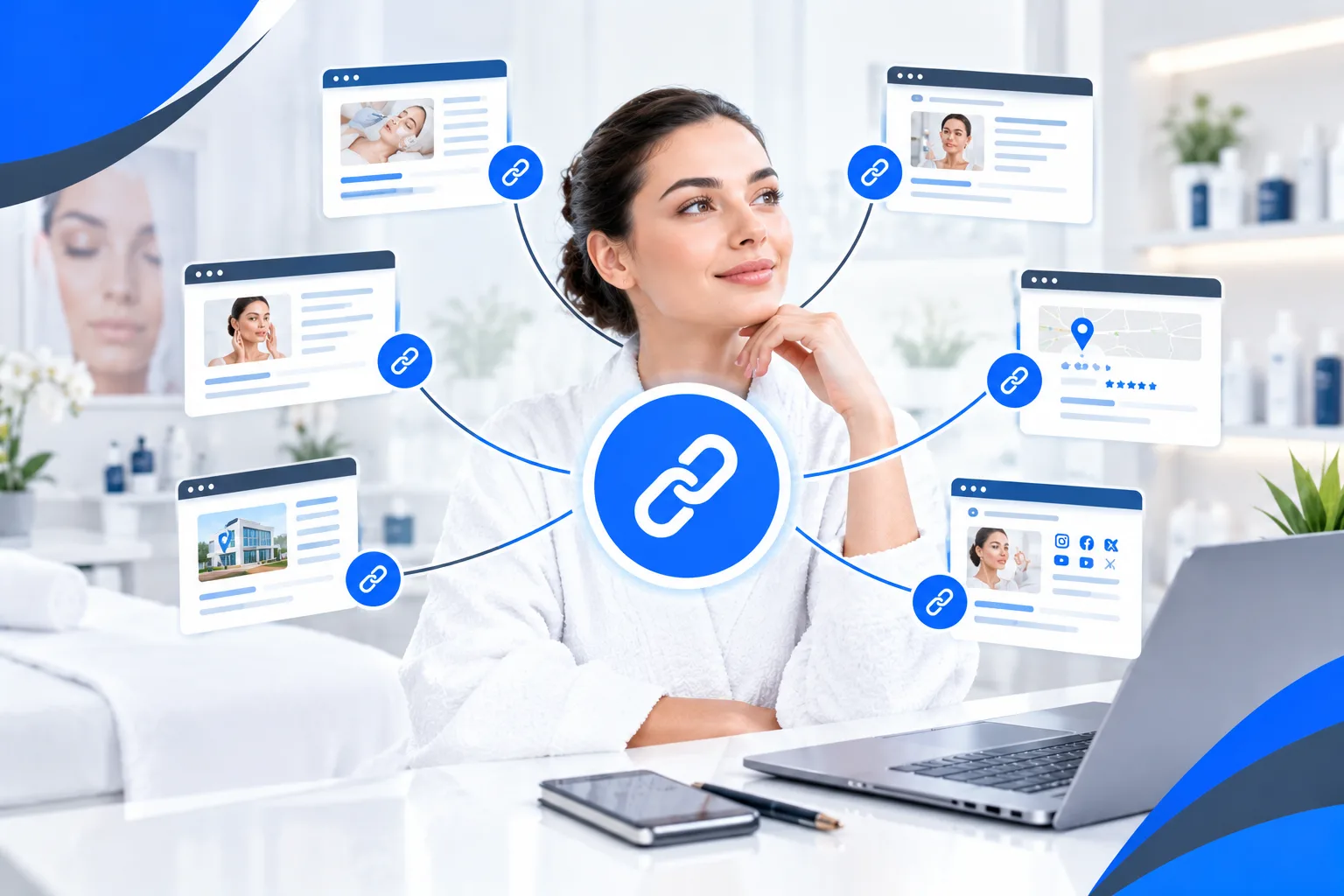
A backlink is simply a link from another site to yours. Google treats each one as a small vote of confidence: if enough relevant, credible sites point to your practice, that’s evidence real people and publishers find it worth mentioning. Med spas sit in a category Google treats with extra scrutiny, since cosmetic and medical treatments can affect a person’s health and finances, so where those votes come from matters more than how many you collect.
Backlinks are one piece of a broader medical SEO strategy that also includes on-page content, local listings, and technical health. They’re often the piece practices neglect longest, mostly because good ones take real outreach rather than a checklist you can knock out in an afternoon.
The Backlink Types Worth Pursuing
Not every link carries the same weight. These are the types that consistently show up in strong med spa link profiles.
Medical and aesthetics-specific directories. Platforms like RealSelf, Healthgrades, and the American Med Spa Association list practices by specialty, which puts the link in a genuinely relevant context. These won’t move rankings dramatically on their own, but they’re foundational. Most med spas should have accurate, complete profiles on the handful that matter for their market before spending time anywhere else.
Local citation and review platforms. Yelp, Apple Maps, Bing Places, and similar listings function more as local trust signals than raw ranking fuel, but consistent name, address, and phone details across them support local pack visibility, and several include a link back to your site.
Editorial and digital PR coverage. A mention or feature in an aesthetics trade publication, a regional lifestyle magazine, or a health-focused outlet is an editorial backlink, earned because a writer or editor decided the practice was worth covering rather than because a fee changed hands. This is the category where digital PR and link building for medical practices [proposed service link confirm target] tends to deliver the most durable results, since the link is harder to get and harder to fake.
Guest content on relevant health and beauty sites. Writing an article for a skincare blog, a wellness publication, or a dermatology-adjacent outlet can earn a contextual link back to your site, provided the placement is topically aligned. Done well, this overlaps with ongoing medical content marketing rather than a one-off favor. A med spa byline on a random finance or tech blog reads as exactly what it is: a link placed for SEO, not for readers, and it does little for either rankings or reputation.
Local news and event sponsorship. Sponsoring a health expo, a charity run, or a community event sometimes earns a link from the organizer’s site or local news coverage. These are usually modest in authority but strong in relevance, since they connect your practice to the area you actually serve.
Content that earns links on its own. Practices that publish genuinely useful material, such as a well-researched explainer or an original patient survey, occasionally get linked to naturally by other sites summarizing or citing the information. This is slower to produce results than direct outreach, but the links tend to be higher quality because nobody had to ask for them.
Journalist source-request platforms. Services that connect reporters with expert sources, such as HARO (relaunched by Featured.com in 2025 after a 2024 shutdown), Connectively, and Qwoted, occasionally lead to a citation and link when a journalist quotes a practice owner or medical director on a relevant story. Response speed and genuine, specific expertise matter more here than volume of pitches.
| Type | Example sources | Follow status | Best for |
|---|---|---|---|
| Medical & aesthetics directories | RealSelf, Healthgrades, AmSpa | Mixed | Foundational trust, occasional referrals |
| Local citations | Yelp, Apple Maps, Bing Places | Often nofollow | Local pack visibility |
| Editorial / digital PR | Regional magazines, aesthetics trade press | Usually followed | Authority and credibility |
| Guest content | Health & beauty blogs, wellness sites | Usually followed | Topical relevance, referral traffic |
| Local news / sponsorship | Event organizers, local news outlets | Mixed | Local relevance |
| Journalist requests | HARO/Featured, Connectively, Qwoted | Usually followed | Occasional high-authority citation |
How to Tell a Good Backlink From a Waste of Time
Before agreeing to any placement, free or paid, run it through a short filter:
- Would this site’s actual readers plausibly be interested in a med spa? A skincare blog qualifies; a general-interest coupon site doesn’t.
- Editorial control. Did a human editor decide to include the link because it added value, or did you (or a vendor) pay to insert it into an existing page? Both can be legitimate, but paid or sponsored placements need the right tag.
- Real audience. Does the site have actual traffic and a publishing history, or does it exist mainly to host outbound links?
- Follow vs. nofollow. A nofollow or sponsored link doesn’t pass the same ranking signal as a standard link, but it can still send referral traffic and build visibility. Don’t dismiss every nofollow opportunity out of hand.
- Geographic fit. For a single-location practice, a link from a local or regional source often does more for map-pack visibility than a fifth national placement.
Did link building take a back seat to running the practice?
Innovaria Tech works with medical and aesthetic practices on healthcare SEO, including the outreach and vetting that backlink building actually requires.
What to Avoid
Buying links to manipulate rankings without disclosure, joining reciprocal link-exchange networks, and placing content on low-quality guest-post farms are all treated as link spam under Google’s published spam policies. Google has said it doesn’t penalize a site simply for having paid or sponsored links, as long as they carry a rel=“nofollow” or rel=“sponsored” attribute. The problem is passing ranking credit through a paid link without that disclosure. Google’s automated systems have also stepped up detection of large-scale, low-value guest-posting operations built mainly to pass links rather than inform readers, so a stack of thin guest posts is a growing liability rather than a shortcut.
For a med spa specifically, low-quality links carry an extra downside beyond SEO risk: a directory or guest-post network with no editorial standards is also unlikely to check the medical or advertising claims in what you submit, which creates a compliance problem before it creates a ranking problem.
Compliance Considerations Most Guides Skip
Backlink outreach for a med spa isn’t purely an SEO question. It touches advertising rules that apply specifically to medical and cosmetic services.
Disclosure on sponsored or paid placements. If a publication features your practice in exchange for payment, free treatment, or any other material benefit, the FTC’s Endorsement Guides require that connection to be disclosed clearly, not buried in a bio link. This applies to influencer collaborations and sponsored guest posts, not just traditional ads.
Before-and-after images used off-site. If a publication or guest post features patient photos, the consent needs to specifically authorize that external use. General treatment consent isn’t enough, and the image still has to represent a typical result rather than a best-case outcome.
Testimonials and patient quotes in earned coverage. If a journalist or guest-post host quotes a patient by name, confirm that patient has actually agreed to be identified in that context. This sits alongside, not instead of, your practice’s usual HIPAA and consent process.
None of this should discourage a med spa from pursuing press or guest content. It just means routing placements through the same review process you’d use for any other patient-facing marketing, rather than treating a backlink opportunity as a purely technical SEO decision.
A Simple Way to Prioritize
Where to start depends on the practice’s size and how much time you can give it:
- Just getting organized: clean up and complete listings on the two or three directories that matter most for your specialty and market, and make sure your name, address, and phone number match everywhere.
- Ready to invest some time: pitch one or two genuinely aligned guest posts a quarter to health or beauty sites, and respond promptly to journalist source requests in your area of expertise.
- Building a sustained program: pair ongoing digital PR outreach with content assets, such as original data or guides, designed to earn links without outreach at all.
If link building keeps sliding down the priority list because it competes with running the practice, that’s usually where med spa SEO services pay for themselves fastest, since outreach and vetting take real hours most owners don’t have free. For a sense of how that kind of ongoing work typically gets budgeted, see how SEO spend usually breaks down for medical practices .
FAQ
Do nofollow backlinks help a med spa’s SEO?
Not in the same way a standard, followed link does, since a nofollow or sponsored tag tells Google not to pass ranking credit through it. But nofollow links still send referral traffic, build brand visibility, and can lead to future followed mentions, so they’re worth having as part of a varied link profile rather than something to avoid.
How many backlinks does a med spa actually need to rank?
There’s no fixed number. A handful of relevant, high-quality links from real aesthetics or local publications typically outperforms dozens of generic directory listings. Focus on consistent, relevant link acquisition over time rather than a target count.
How long does it take for a new backlink to affect rankings?
It varies by site and competition, but most practices see some ranking movement from a new relevant link within a few weeks to a couple of months, not overnight. Editorial links from established publications tend to carry weight faster than links from brand-new or low-authority sites.
Should a med spa buy backlinks or use a paid link-building service?
Buying links specifically to manipulate rankings, without disclosure, violates Google’s spam policies and risks a penalty. Paying an agency for legitimate outreach, PR, or guest-posting work is different and common. The distinction is whether placements are earned through real editorial relationships and properly tagged when sponsored, not fabricated at scale.
Is HARO or its successors still worth using for med spa backlinks in 2026?
Yes, with the caveat that the landscape has changed. The original HARO brand was discontinued in December 2024 and relaunched by Featured.com in 2025, and Connectively and Qwoted are active alternatives. All of them work the same basic way: a practice owner or medical director responds to a journalist’s request with genuine expertise, and a strong, specific answer earns a citation and a link.