
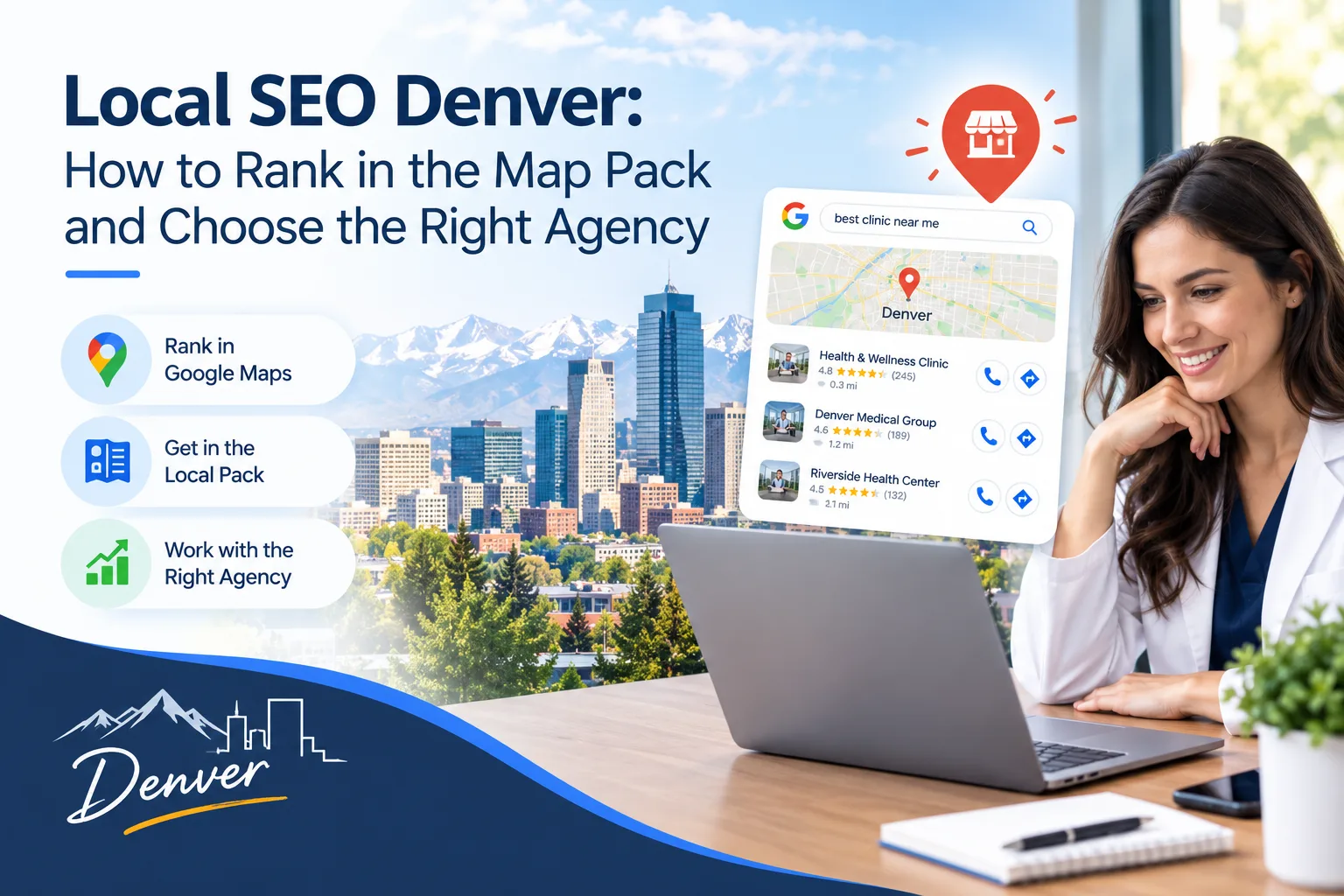
Local SEO in Denver is the work of getting your business to appear in Google Maps, the local pack, and city-specific searches when someone in the Denver metro is ready to call, book, or visit. Google ranks those results on three signals it names publicly: relevance, distance, and prominence. You can’t change distance, so the gains come from a complete Google Business Profile, a steady flow of genuine reviews, consistent business details across the web, and pages that prove you serve the neighborhoods you claim. For healthcare businesses looking to strengthen their visibility across the state, see our healthcare SEO services in Colorado.
This guide covers how local rankings work, why a Denver ranking changes from block to block, what a Denver local SEO company should actually do, what it costs, how long it takes, and how to vet an agency before you sign. If you run a medical, dental, or behavioral health practice, one section covers the extra rules that apply to you. For a deeper look at local SEO for healthcare practices, see our guide on local SEO for healthcare practices.
Quick answers
- What it is: optimizing for Maps, the three-business local pack, and Denver-specific searches.
- How long: Google says edits to your profile can take up to 3 days to appear and new businesses can take up to a month to rank. Denver agencies that publish timelines quote roughly 1 to 3 months for first map movement and 3 to 6 months for stable results across several areas.
- What it costs: some Denver agencies publish ranges of about $1,000 to $2,500 per month for typical local programs, with higher figures in competitive verticals.
- Biggest mistake: judging your ranking from your own office.
Table of Contents
ToggleWhat is local SEO in Denver?
Local SEO in Denver is the practice of optimizing a business so it shows up for searches made by people in and around Denver, Colorado. It appears in three places: the local pack (the map with three business listings at the top of the page), Google Maps, and organic results for queries that include a Denver neighborhood or city name. More and more, it also feeds the AI-generated answers that name a business when someone asks for a recommendation.
It differs from standard SEO because the local pack ranks on a different mix of signals. Your profile, your reviews, and the searcher’s distance from you carry more weight there than your blog content does. That’s why a business can sit on page one of the blue links and still be missing from the map. A pediatric dentist in Wash Park, for example, can rank well for “pediatric dental care tips” and still lose “pediatric dentist near me” to a competitor with a better-maintained profile two blocks closer to the searcher.
Denver local SEO also has a conversion advantage. Someone typing “urgent care Capitol Hill” is choosing a provider, not researching a topic. That intent is why so many Denver businesses fight over three map slots. For healthcare practices looking at the broader search strategy behind local visibility, see our guide on what medical SEO is.
How does Google rank local results?
Google’s Business Profile Help Center says local results depend mainly on relevance, distance, and prominence, and it states that there is no way to request or pay for a better local ranking (Google Business Profile Help). Each signal answers a different question.
| Signal | The question Google is answering | What you can influence | Denver example |
|---|---|---|---|
| Relevance | How well does this business match the search? | Complete profile details, an accurate primary category, services, and website content | A profile categorized as “Physical therapy clinic” matches “physical therapist Denver” more closely than one filed under a generic category |
| Distance | How far is the business from the searcher or the area named in the search? | Your address accuracy and one profile per real location. You can’t move the building | A searcher in Highlands sees nearby clinics first, even if a better-reviewed one sits in Aurora |
| Prominence | How well known is this business? | Review count and rating, local links, press, associations, and mentions | A practice with 140 recent reviews and local press coverage outranks a newer neighbor with eight |
you’ll find ranking-factor percentage charts on many agency pages. They come from practitioner surveys, not from Google, so use them to prioritize work and not as proof of cause. Because Google says a better position can’t be bought, treat any promise of a guaranteed map pack spot with skepticism.
Why does your Denver ranking change from one neighborhood to the next?
Distance applies to every search location, so there’s no single “Denver ranking” to hold. Cherry Creek, RiNo, Capitol Hill, the Denver Tech Center, and suburbs like Aurora, Lakewood, and Centennial each show a different set of competitors for the same query. The one place you’re guaranteed to look good is the building where you check your rankings, and that’s exactly where most owners check.
Run this five-point test before you spend a dollar:
- Pick three searches a new customer would type. Use the service plus a neighborhood or “near me,” never your business name.
- Search from five locations: your address, two points a few miles away in different directions where your customers live, downtown, and one suburb you want to win. A rank-tracking tool that lets you set the search location works, or you can run the searches from a phone while you’re there.
- Record your position and the three businesses above you at each point.
- Compare the results across points.
Then read the pattern:
| What you see | Likely cause | First fix |
|---|---|---|
| Strong near you, weak farther out | Prominence gap | Reviews, local links, and location pages for the areas you want |
| Weak everywhere, including next door | Relevance or profile problem | Primary category, services, completeness, verification status |
| Missing entirely | Something broken | Check for suspension, a duplicate listing, or an unverified profile |
| Strong everywhere | Your local presence is healthy | Put the budget into converting visits into calls |
This is a diagnostic rule of thumb, not a Google rule, but it keeps the first conversation with any agency grounded in your own data.
What do local SEO services in Denver include?
A credible scope covers seven pieces of work. Ask any Denver local SEO marketing company to show you which ones your test results call for.
| Component | What it does | Why it matters |
|---|---|---|
| Google Business Profile optimization | Sets categories, services, hours, photos, attributes, and service areas | Feeds relevance, and it’s the fastest lever because edits show up within days |
| Review system | Builds a steady, compliant review request process and a reply routine | Feeds prominence and the click decision |
| Citation and NAP cleanup | Makes name, address, and phone identical across your site and directories | Prevents fragmented business data that confuses search engines and AI tools |
| Location and service pages | Publishes pages with real local substance | Gives Google and customers a reason to match you to a place |
| Local schema | Adds structured data that states your business facts in machine-readable form | Supports consistent entity understanding |
| Local links and mentions | Earns links from chambers, associations, suppliers, and local press | Builds prominence over months |
| Tracking and reporting | Measures calls, direction requests, form fills, and bookings | Proves whether any of it works |
Scope should follow diagnosis. If your profile is half complete, you don’t need a link-building retainer yet.
Google Business Profile: what should you fix first?
Fix the profile before anything else, because it controls how you appear in Maps and the local pack and because changes show up quickly. Google says edits can take up to 3 days to appear in results (Find your business on Google).
- Verify the profile. Google says only verified businesses can show their info on Maps and Search.
- Choose the most specific primary category that is truthfully yours, then add secondary categories for real secondary services.
- Enter hours that match reality, including holiday hours.
- Show your address only if customers visit you. If you travel to customers, set a service area instead.
- Create one profile per real location where people can meet your staff.
- List services and attributes, upload recent photos of the real premises, and answer customer questions.
- Use your real business name. Stuffing “Denver” or a service into the name violates Google’s guidelines, and profiles that break them can be disabled or suspended.
Ready to Improve Your Denver Local Search Visibility?
If your healthcare practice isn’t consistently appearing in Google Maps, the local pack, and Denver-specific searches, it may be time to fix the gaps holding your visibility back. From Google Business Profile optimization and review strategy to local content, citations, and location signals, the right local SEO work can help more Denver patients find and choose your practice.
Want to build a stronger healthcare search presence across Denver and Colorado? Explore our healthcare SEO services in Colorado and see how Innovaria Tech can help strengthen your local visibility.
How do you earn reviews without risking your profile?
Google states that more reviews and positive ratings can help a business’s local ranking, so a review process is a ranking project as well as a reputation project. Build it into your workflow rather than running it as a campaign.
Ask at the moment a customer has just seen the result, send a direct link so leaving a review takes one tap, and ask every customer, not only the ones you expect to be happy. Reply to every review in a calm, specific voice. Don’t buy reviews, and don’t script keywords into what customers should write. A steady monthly flow reads as real; a sudden burst of 40 reviews in a week reads as manufactured to Google and to customers.
Healthcare practices need one extra rule. A public reply that confirms a reviewer is your patient can disclose protected health information, so keep replies generic, thank the reviewer, and move any detail to a private channel. For more on protecting patient information while handling SEO, see our guide to HIPAA compliance and medical SEO.
What should Denver location pages and your website do?
Your website supports your profile by confirming the same facts and by giving Google something worth matching to each area. A location page earns its place only when it contains information that is true of that place and nowhere else: the providers or staff who work there, the parking or light rail access, the cross streets, the services offered at that site, and hours that match the profile.
A template with “Aurora” swapped for “Lakewood” adds nothing, and customers see through it as quickly as Google does. If you can’t write something genuinely different for a suburb, don’t build the page yet. Keep your name, address, and phone number identical to the profile, embed a map, and link each location page from your main navigation or a locations hub.
Structured data helps here. A practice can mark up its organization, locations, and providers so search engines read the same facts you publish; our guide to structured data setup for medical practices walks through the types that apply.
Local SEO for Denver healthcare practices
Denver patients search by specialty, neighborhood, insurance, and availability: “dermatologist Cherry Creek accepting new patients,” “pediatrician open Saturday,” “therapist telehealth Denver.” Independent practices compete in the same pack as large systems such as UCHealth, Denver Health, and HCA HealthONE, so specialty-plus-neighborhood relevance is how a smaller practice earns its slot.
Google also holds medical content to a higher standard of accuracy and trust, which makes provider credentials and clear authorship part of the local work. Innovaria Tech covers the statewide picture on its page about healthcare SEO services in Colorado, and the healthcare SEO services for clinics and hospitals page lists the service scope. For Denver, these are the practical priorities:
- Give each provider a page with credentials, specialties, and the locations where they see patients.
- State insurance accepted, new-patient availability, and telehealth options in plain text on the site and in the profile.
- Match categories to the care you actually deliver, such as “Pediatric dentist” rather than a broader label.
- Treat each office as its own entity. Multi-location groups often fail by cloning one page, a problem covered in why multi-location providers struggle with local visibility.
- Review your tracking setup. The pillar page explains that Colorado’s privacy law can treat health-condition data as sensitive, and the article on how HIPAA compliance affects medical SEO covers analytics and pixels. Confirm your own obligations with counsel, since this is marketing guidance and not legal advice.
How does AI search change local SEO in Denver?
AI answers about local businesses draw on the same raw material as the map pack: your profile, your reviews, your website, and what directories say about you. Reports on how often AI features appear for local searches disagree, so I won’t hand you a percentage. What the sources agree on is the groundwork: a complete profile, genuine reviews, and business facts that match everywhere. If your hours differ between your site and your profile, an AI system has no way to know which to trust.
How much does local SEO cost in Denver, and how long does it take?
Independent benchmarks are scarce. The figures below come from Google’s help pages and from agencies that publish their own ranges, so use them to sanity-check a quote and not as a market average.
| Item | What’s documented | Source type |
|---|---|---|
| Profile edits showing in results | Up to 3 days | |
| New business appearing in rankings | Up to about a month | |
| First map pack movement | Roughly 30 to 90 days | Denver agency pages |
| Stable results across several areas | Roughly 3 to 6 months | Denver agency pages |
| Monthly retainer for a typical program | About $1,000 to $2,500 | One Denver agency’s published range |
Cost rises with the number of locations, how crowded your category is, how much citation and review repair is waiting, how many location pages you need, and whether compliance work is involved. Healthcare and legal sit at the higher end. If you run a practice, the article on what medical SEO costs breaks the budget down further.
How do you choose a Denver local SEO company?
Searching for a Denver local SEO company returns many near-identical pages, so judge on evidence you can request. An agency for local SEO in Denver doesn’t need a downtown office, but it does need to test your visibility from Denver locations.
- Ownership: you own the Google Business Profile and analytics, and the agency gets manager access.
- Diagnosis first: ask for neighborhood-level ranking findings before a proposal.
- Written scope: deliverables are named, not described as “optimization.”
- Reporting: results tie to calls, direction requests, form fills, and bookings, not rankings alone.
- Review policy: no purchased or gated reviews.
- Location pages: ask to see two examples that are visibly different from each other.
- Industry fit: a healthcare practice needs a team that understands HIPAA and state privacy rules.
- References: you can speak to a current client in a similar category.
Our checklist of questions to ask a medical SEO provider works for most local SEO vendors, not only medical ones.
| Red flag | Why it matters |
|---|---|
| Guaranteed map pack or #1 ranking | Google says local ranking can’t be bought |
| Virtual office or extra “locations” to widen reach | Breaks profile guidelines and risks suspension |
| Bulk citation blasts | Inconsistent data does more harm than good |
| Contract that withholds access to your accounts | You can’t leave without losing your assets |
| One page cloned across every suburb | Rarely ranks and weakens trust |
Should you do local SEO yourself or hire an agency?
| Situation | Recommended path | Reason |
|---|---|---|
| One location, light competition | Do the profile and reviews yourself | These steps are free and carry most of the early gain |
| One location, crowded Denver category | Hire a consultant for diagnosis, then split the work | Prominence work takes sustained effort |
| Two or more locations | Hire an agency | Each location needs its own profile, page, and review flow |
| Regulated practice | Hire a specialist | Review replies and tracking carry privacy risk |
A 90-day Denver local SEO plan
Weeks 1 and 2: diagnose
- Run the five-point test and save the results
- Verify the profile and correct category, hours, address, and service area
- List every directory that shows your name, address, and phone
- Set up call, direction, and form tracking
Weeks 3 to 6: fix and build
- Correct mismatched listings
- Add a review request to your normal customer workflow
- Publish or rewrite location and service pages with real local detail
- Add local schema
Weeks 7 to 12: grow and measure
- Earn links from a chamber, an association, a supplier, or a local sponsorship
- Keep review replies current
- Re-run the five-point test and compare it with your baseline
Common Denver local SEO mistakes
Checking rankings from your own office is the most common error, and it hides every weakness. Close behind are cloned suburb pages, a business name padded with keywords, address formats that differ between the site and the profile, review requests that stop after one burst, and tracking tools added to a healthcare site without a privacy review. Opening a virtual office to appear closer to downtown looks clever and often ends in a suspended profile.
Frequently asked questions
How much does local SEO cost in Denver? Agencies that publish prices describe typical programs at roughly $1,000 to $2,500 per month, with competitive verticals such as medical and legal costing more. Scope, number of locations, and cleanup needs decide where you land.
How long does local SEO take in Denver? Profile edits can appear within 3 days according to Google, and agencies commonly quote 1 to 3 months for first map movement and 3 to 6 months for stable multi-area results. Crowded categories take longer.
Can I rank in Denver if my office is in a suburb? Yes, but distance works against you for searches centered downtown. Build prominence, publish real pages for the areas you serve, and keep your address honest.
Do I need a Denver address to do local SEO in Denver? Only a real one counts. If you serve customers at their location, set a service area instead of showing an address. Don’t use a virtual office.
Is local SEO different from regular SEO? Yes. Local SEO targets Maps and the local pack, where your profile, reviews, and proximity matter most, while regular SEO targets organic results driven by your site’s content and authority.
Do reviews really affect rankings? Google says more reviews and positive ratings can improve local ranking. Recency and replies matter to customers too.
Can local SEO help me appear in AI answers? It builds the groundwork those answers use: a complete profile, genuine reviews, and consistent facts across the web.
Where to start
Run the five-point test this week, and write down where you disappear. If you run a Denver practice and want help turning those gaps into a plan, talk to Innovaria Tech about your Denver visibility gaps.