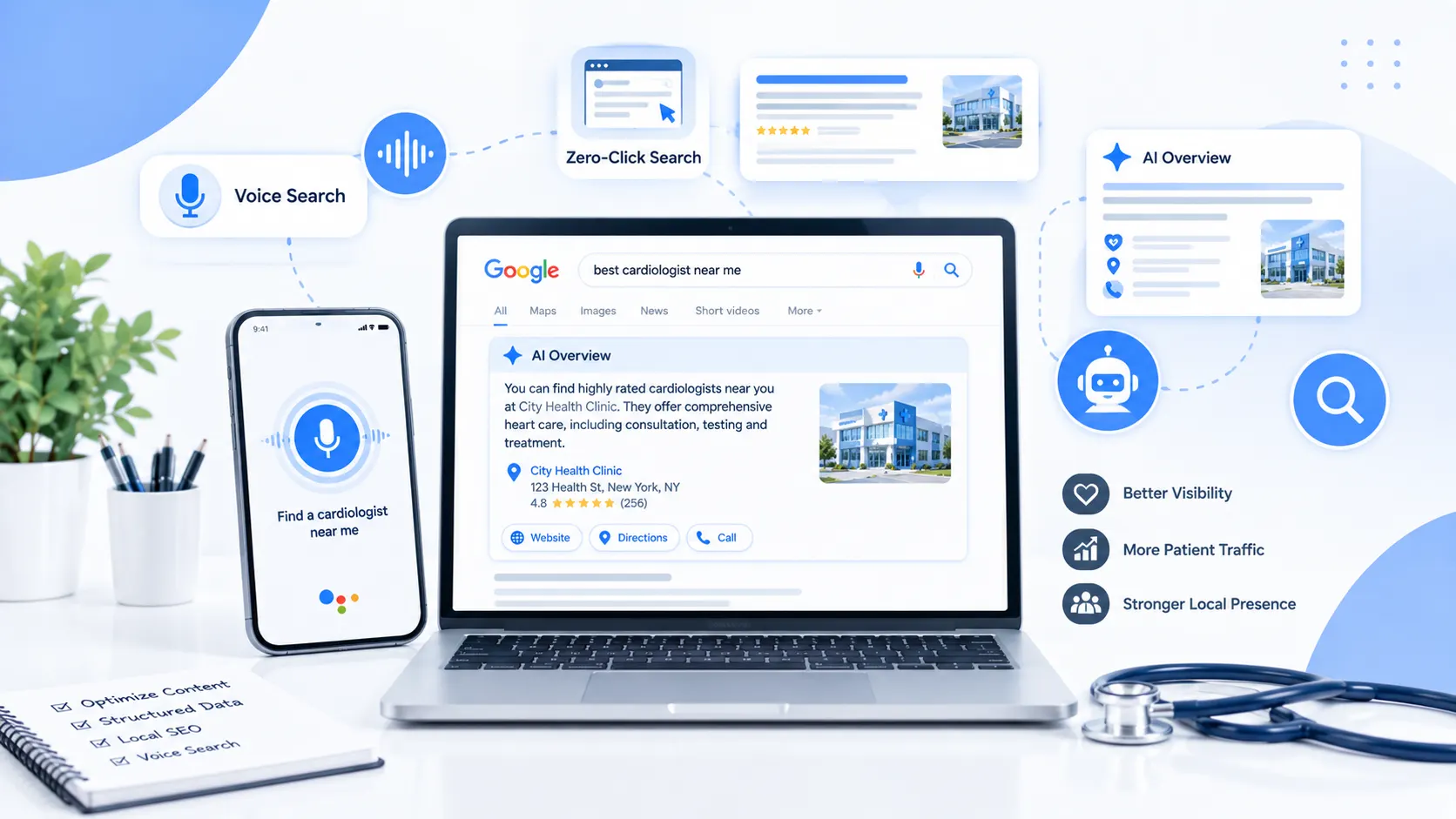
Zero-click search means a patient gets an answer inside Google or an AI assistant before your website ever loads. In healthcare, that is no longer an emerging risk. It’s already the default behavior for most symptom, provider, and cost questions. Adapting your healthcare SEO strategy for this environment means building content, structured data, and local listings that AI systems can read, verify, and cite not just pages designed to rank on a results page patients increasingly skip.The scale of the shift is worth sitting with for a second. Zero-click behavior across all search categories has climbed from roughly half of all queries in 2019 to somewhere near two-thirds today. Health-related searches trigger an AI-generated summary at an even higher rate than the average query, and when that summary appears, the organic result underneath it typically sees a steep drop in clicks. For a specialty practice or a multi-location health system, that’s not a minor ranking fluctuation. It’s a structural change in how new patients discover care.
This guide walks through why the shift matters specifically for healthcare, how it’s reshaping SEO strategy, what to actually change on your website, and how voice search fits into the same picture.
Table of Contents
ToggleWhy Zero-Click Search Matters More in Healthcare Than in Most Industries
A handful of factors make this shift hit healthcare harder than retail or general local business categories.
Health content sits in Google’s “Your Money or Your Life” category. Search engines and AI systems apply a higher bar for accuracy and trust before they’ll surface or cite medical information. That cuts both ways: it’s harder to get cited, but the sources that do get cited carry real credibility with the patient reading the summary.
Local and urgent intent dominate the query mix. Searches like “urgent care near me” or “OB-GYN accepting new patients” resolve directly inside the map pack or an AI answer, with no organic click required at all. These queries were already local-heavy before AI search; now they’re often fully self-contained.
Trust transfers from the platform to the practice. When an AI Overview names your practice or a specific condition page, the patient reads that as an implicit endorsement, similar to a referral. Being the cited source even without a click still builds the kind of recognition that shows up later as a direct or branded search.
Patient acquisition economics are unforgiving. Organic visibility has historically converted at a lower cost than paid channels for healthcare. Losing that channel to a zero-click answer doesn’t just cost traffic; it pushes acquisition spend toward paid channels that are also seeing their own click-through rates erode as AI summaries appear above ads.
None of this means organic visibility stopped mattering. It means the goalpost moved from “get the click” to “get selected as the source, and win the click when one is actually available.”
How Zero-Click Search Is Reshaping Healthcare SEO Strategy
The old model was simple: rank, get clicked, convert. That model still exists, but it now shares the results page with two other systems competing for the same query the local pack, powered by your Google Business Profile, and the AI Overview or AI Mode summary, powered by structured data and citable content pulled from across the web.
These three systems are not separate projects. They draw from overlapping inputs: the same page speed, the same structured data, the same content accuracy, and increasingly the same review and citation signals. A healthcare SEO strategy built for 2026 treats them as one connected system rather than three separate line items, because the technical and content work that earns a citation in an AI Overview is largely the same work that earns a top-three map pack position and a page-one organic ranking.
The practical shift is in what you measure and what you build for:
- Measure citation share alongside rankings. If you can see which AI platforms mention your practice or content for your priority queries, track that the same way you’d track keyword position.
- Track calls and bookings from your Google Business Profile as their own channel, since a growing share of “near me” and urgent-intent traffic never reaches your website at all.
- Write to be extracted, not just read. A direct, self-contained answer near the top of a section is more useful to both a skimming patient and a summarizing model than a long narrative build-up.
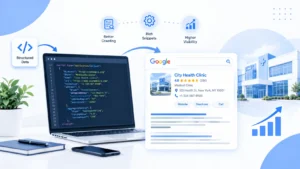
- Treat structured data as infrastructure, not decoration. It’s the layer that tells search engines and AI systems what your content actually says, reducing the chance they guess wrong or skip you entirely.
How AI Overviews and Answer Engines Choose Healthcare Sources
Understanding the selection criteria is the difference between guessing at tactics and building deliberately.
Authorship and credentials matter more for health content than almost any other category. Content with a named, credentialed author a physician, a credentialed administrator, a subject-matter specialist carries more weight than unattributed pages. Byline, credentials, and a visible last-updated date all function as trust signals that a generative system can parse.
Direct-answer formatting increases extraction odds. Opening a section with a concise, self-contained answer (roughly 40–60 words) before expanding into detail gives a model a clean passage to lift. Burying the actual answer under three paragraphs of throat-clearing does the opposite.
Schema doesn’t buy you a citation, but it removes ambiguity. Google has been explicit that no special markup is required to appear in an AI Overview. What structured data does is confirm, in a machine-readable way, facts that might otherwise require inference who wrote the page, what organization stands behind it, what question a given block of text actually answers. Some structured-data research has found that pages with well-implemented FAQ markup appear in AI-generated answers more often than pages without it, though the underlying content still has to earn that placement on its own merits.
Consistency between visible content and structured data matters. Schema that claims something the page doesn’t actually say does more damage than no schema at all it reads as unreliable to systems that increasingly cross-check the two.
Search visibility is ultimately a patient-access and revenue question.
If your practice’s provider data, website, and search strategy need to work together as one accurate, consistent system, our team can help you review where the gaps are.
How to Prepare Your Healthcare Website for AI Search
This is where strategy turns into a build list. Four areas do most of the work.
1. Structured data that matches what’s actually on the page
Start with Organization schema name, logo, official social profiles, and NPI where relevant as the foundational identity layer every other schema type builds on. Layer Article or BlogPosting schema on content, with author and publisher properties correctly linked. Add FAQPage schema only to genuine, visible Q&A content; the questions and answers in the markup have to match what a visitor actually sees on the page, word for word. Getting the technical implementation and the surrounding site architecture right, from clean templates to properly linked schema, is foundational enough that many practices bring in dedicated medical website development support rather than bolting schema onto an existing template as an afterthought.
2. A deliberate decision about which AI crawlers get access
This is the step most practices skip entirely, and it’s easy to get backwards. AI companies run two distinct types of bots, and confusing them can quietly remove your practice from AI answers. Training crawlers (GPTBot, Google-Extended, and similar) collect content to train future models. Retrieval or citation crawlers (OAI-SearchBot, Claude-SearchBot, and standard Googlebot, which also feeds AI Overviews) fetch pages in real time to ground and cite an answer for a live user query. Blocking a training crawler costs you nothing in visibility. Blocking a retrieval crawler can remove your practice from AI answers entirely, even if your organic rankings look fine. A newer file, llms.txt, works alongside robots.txt as a curated pointer to your highest-signal pages it doesn’t control access on its own, so the two files need to agree with each other rather than send conflicting signals.
3. Content formatted for clean extraction
One clear H1 per page, question-based H2s that mirror how patients actually phrase things, and lists or tables wherever information is genuinely enumerable dosages, appointment prep steps, insurance requirements, comparison factors. Page speed still matters here too: a slow page is a bad experience for a human visitor and a deprioritized fetch for a crawler working against a time budget.
4. A tracking setup that doesn’t create a compliance problem while you measure any of this
Standard Google Analytics and Meta Pixel implementations are not HIPAA compliant on their own neither Google nor Meta will sign a Business Associate Agreement for their default consumer tools. On a general marketing blog post, that risk is low. On condition-specific pages, symptom checkers, or anything near an appointment-request form, a standard pixel can capture and transmit information that qualifies as protected health information without anyone intending it to. The practical fix is server-side tracking or a healthcare-specific analytics platform operating under a signed BAA, with a clear line drawn between marketing measurement and anything that touches patient data. This is a step most general SEO guidance skips entirely, and it’s exactly the kind of detail that separates a healthcare-specific strategy from a generic one.
How Voice Search Is Changing Patient Discovery
Voice search and AI search overlap more than most practices realize, because both are answering a spoken or typed question directly rather than returning a list of links.
Adoption in healthcare specifically has moved past the experimental stage. Roughly a third of patients have already used voice search to find a healthcare provider, and healthcare and wellness rank among the most common categories people use voice assistants for at all. “Near me” voice queries for medical offices have been growing at a fast clip year over year, and a large share of healthcare organizations have already adopted, or are actively piloting, voice technology for patient-facing engagement.
Three things change when a query is spoken instead of typed:
- Queries get longer and more conversational. “Find me a dermatologist near me who takes Blue Cross” replaces “dermatologist Blue Cross [city].” Content written in natural, question-and-answer language matches this pattern better than clipped keyword phrases.
- Follow-up questions are now common. Modern voice assistants can hold several turns of context, so a patient might ask a follow-up about cost or availability in the same conversation. FAQ content that anticipates the next logical question performs better than a single, isolated answer.
- Most healthcare voice queries resolve through the same local data as an AI Overview or map pack result, meaning the fix for voice search visibility and the fix for local AI visibility are, in practice, the same fix: an accurate, complete Google Business Profile.
Your Google Business Profile Is Now Part of Your SEO Content
It’s worth treating this as content, not just a directory listing, because that’s increasingly how AI systems treat it too.
Consumer reliance on Google to evaluate local businesses, including healthcare providers, sits at a level where a large majority check it before choosing where to go, and a meaningful share won’t consider a provider below a certain star rating at all. On top of that, research on AI-generated local answers has found that Google Business Profile data anchors a significant share of the citations behind AI-driven local recommendations arguably more than any other single source.
One finding worth building your strategy around: independent testing of AI-generated local recommendations found that these systems tend to recommend brands they already recognize, not simply the page that’s technically best optimized for a keyword. A practice name that reads to a language model as a generic category description, rather than a distinct, consistently-cited brand, gets passed over even when its content ranks well. Consistent naming and complete, accurate information across every platform where your practice appears is what builds that recognition.
That consistency extends beyond Google itself. The same directories, registries, and payer systems that keep your practice’s provider data accurate for billing and network purposes function as an off-site trust layer for search visibility too. A mismatch between what your website says and what’s on file with the NPI registry, your insurance directories, or your CAQH profile creates the same kind of inconsistency that undermines schema markup it gives search and AI systems conflicting signals about a basic fact like your practice’s address or accepted insurance. Understanding what physician credentialing actually verifies makes it easier to see why this data has to stay synchronized across every system it touches, not just the ones patients see directly. Practices actively enrolling or revalidating with Medicare can confirm their current standing through a PECOS enrollment lookup, which is one more place that record needs to match what’s published everywhere else.
A Practical Framework: Where You Can Still Win the Click
Not every query type behaves the same way in a zero-click environment. Knowing which is which changes where you spend effort.
| Query type | What typically happens now | Where the opportunity is |
|---|---|---|
| Definitional (“what is [condition]”) | Answered directly in an AI Overview; click unlikely | Win by being the cited, trusted source not the click |
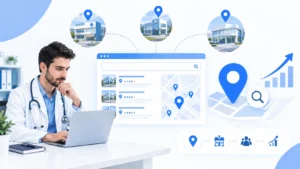
| “[Specialty] near me” | Resolved in the map pack or a local AI answer | Win through Google Business Profile completeness and reviews |
| Cost or insurance-coverage questions | Too plan-specific to fully resolve in a generic summary | Clicks remain likely; a clear, specific page still converts |
| Treatment comparisons (“A vs. B”) | AI may summarize, but users often click through for reassurance | Strong opportunity for genuinely thorough comparison content |
| Transactional (“book with a [specialty] who takes [insurance]”) | Often resolves straight to a call or booking action | Win through structured booking data and a fast path to act |
The pattern across every row: the more generic and low-stakes the question, the more likely it gets absorbed entirely. The more specific, personal, or high-stakes the decision, the more likely a real visit still happens if the page that would answer it exists and is easy to find.
AI-Search Readiness Checklist
- Organization, Article, and FAQPage schema implemented and verified against the visible page content
- Author bylines with real credentials on clinical or clinically-adjacent content
- Deliberate, documented robots.txt and llms.txt rules distinguishing training crawlers from retrieval/citation crawlers
- Every page opens with a direct, self-contained answer before expanding into detail
- Google Business Profile fully complete: correct category, services, attributes, photos, and an active review response cadence
- NPI, CAQH, insurance directory, and website listings checked for matching name, address, phone, and specialty data
- Analytics and tracking setup reviewed for HIPAA exposure on condition pages, symptom tools, and appointment forms
- Core Web Vitals and mobile page speed within acceptable thresholds sitewide
Common Mistakes to Avoid
- Chasing search volume instead of intent. A high-volume keyword that gets fully answered by an AI summary may deliver far less real value than a lower-volume, more specific query that still drives a click.
- Treating the Google Business Profile as a one-time setup. Categories, services, and photos need the same ongoing attention as website content.
- Skipping authorship on clinical content. Unattributed medical content is exactly the kind of source both traditional E-E-A-T guidelines and AI selection criteria are built to filter out.
- Letting provider data drift out of sync. A practice that updates its website but not its NPI, CAQH, or payer directory listings is sending conflicting signals to the same systems it’s trying to earn trust from.
- Bolting on analytics without a compliance check. A default pixel implementation on a condition page or booking form is a common, avoidable exposure.
Is your practice visible where patients search and AI answers?
Zero-click searches and AI Overviews have fundamentally changed how patients find medical care. Let our team audit your structured data, optimize your site for AI citation, and protect your patient acquisition.
Frequently Asked Questions
Why do zero-click searches matter for healthcare SEO specifically? Because health searches trigger AI-generated answers at a higher rate than most other categories, and healthcare’s local, urgent-intent queries were already prone to resolving without a click. Losing that visibility affects patient acquisition more directly than in lower-stakes industries, where a missed click is a smaller loss.
How do zero-click searches impact healthcare SEO strategy overall? They shift the goal from ranking for a click to being selected as a trusted, citable source across organic results, the local pack, and AI-generated summaries. Strategy now has to account for all three surfaces as one connected system rather than optimizing for rankings alone.
How do I adapt my healthcare SEO for zero-click searches? Focus on structured data that matches your visible content, authorship and credentials on clinical pages, a complete and accurate Google Business Profile, and content written to answer a question directly and completely near the top of each section.
How do I prepare my healthcare website for AI search? Implement Organization, Article, and FAQPage schema accurately; make a deliberate decision about which AI crawlers can access your site; format content for direct-answer extraction; and confirm your analytics setup doesn’t expose protected health information on patient-facing pages.
How can voice search impact healthcare SEO? Voice queries tend to be longer, more conversational, and resolved through the same local data that powers AI Overviews and the map pack. A complete Google Business Profile and FAQ-style content written in natural language improve visibility across voice, local, and AI search at the same time.
The Fundamentals Still Carry the Weight
None of this replaces the basics. AI Overviews and voice assistants still draw heavily from pages that already rank well, so a fast site, genuine expertise, and accurate information remain the foundation everything else sits on top of. The practices that lose ground here are usually the ones that let one part of that foundation, whether it’s technical performance, provider data accuracy, or content depth, quietly go stale.