
Table of Contents
ToggleWhat Structured Data Actually Does on a Healthcare Website
Structured data is a standardized vocabulary, maintained by schema.org’s health and medical vocabulary, that gets added to a page’s code, almost always as JSON-LD, a script block that sits separately from the visible content, to describe entities and the relationships between them. A paragraph of text might say “Dr. Patel is a board-certified cardiologist at Riverside Heart Center.” A search engine reading that sentence has to infer who’s a person, who’s an organization, and what specialty applies. A Physician schema entry states it directly: name, medicalSpecialty, affiliation, and credential, each in its own labeled field. Nothing about the page’s appearance changes. What changes is how confidently a machine can extract facts from it.
That health and medical vocabulary was built specifically for this problem, with input from clinical reviewers and research institutions, because generic business schema, name, address, phone number, doesn’t capture what makes a healthcare entity a healthcare entity: specialties, conditions, procedures, and how they connect. That’s the gap healthcare-specific schema types close.
The Core Schema Types Healthcare Websites Need
Not every page needs every schema type, and using the wrong one is worse than using none. The table below maps the types that matter most to the pages where they belong.
| Page type | Recommended schema | Why it matters |
|---|---|---|
| Homepage & practice-level pages | MedicalOrganization or a more specific subtype (MedicalClinic, MedicalBusiness, Hospital, Dentist) | States what kind of medical entity you are, not just that you’re a local business |
| Individual provider pages | Physician, with medicalSpecialty and affiliation | Connects a named doctor to their credentials, specialty, and practice |
| Service or treatment pages | MedicalProcedure or Service, linked to the relevant MedicalCondition | Builds entity relationships between symptoms, conditions, and treatments |
| Location pages | Address, geo, and openingHours nested inside the medical entity type | Feeds the local pack and “near me” results |
| Educational blog content | Article or MedicalWebPage, with author, reviewedBy, and lastReviewed | Reinforces experience, expertise, authority, and trust (E-E-A-T) |
| Genuine FAQ sections | FAQPage, limited to real on-page questions | Supports expandable answer displays where eligible |
| Site-wide navigation | BreadcrumbList | Clarifies site hierarchy for crawling and display |
Two of these deserve more explanation, because they’re where most healthcare sites either add the most value or make the most avoidable mistakes: MedicalOrganization/MedicalClinic and Physician. Both extend the same base type search engines use for local business signals, so they carry address, phone number, hours, and service area automatically. But because they’re medical-specific, they also carry properties a generic LocalBusiness listing can’t: medicalSpecialty, availableService, and board affiliation among them. A search engine reading LocalBusiness markup knows you’re a business at an address. Reading MedicalClinic markup, it knows you’re a business at an address that treats specific conditions with specific providers. That’s a meaningfully more useful signal, and it works best as part of a broader healthcare SEO services strategy rather than a standalone technical task.
How Structured Data Supports Rankings, Rich Results, and Local Visibility
Three mechanisms do most of the work.
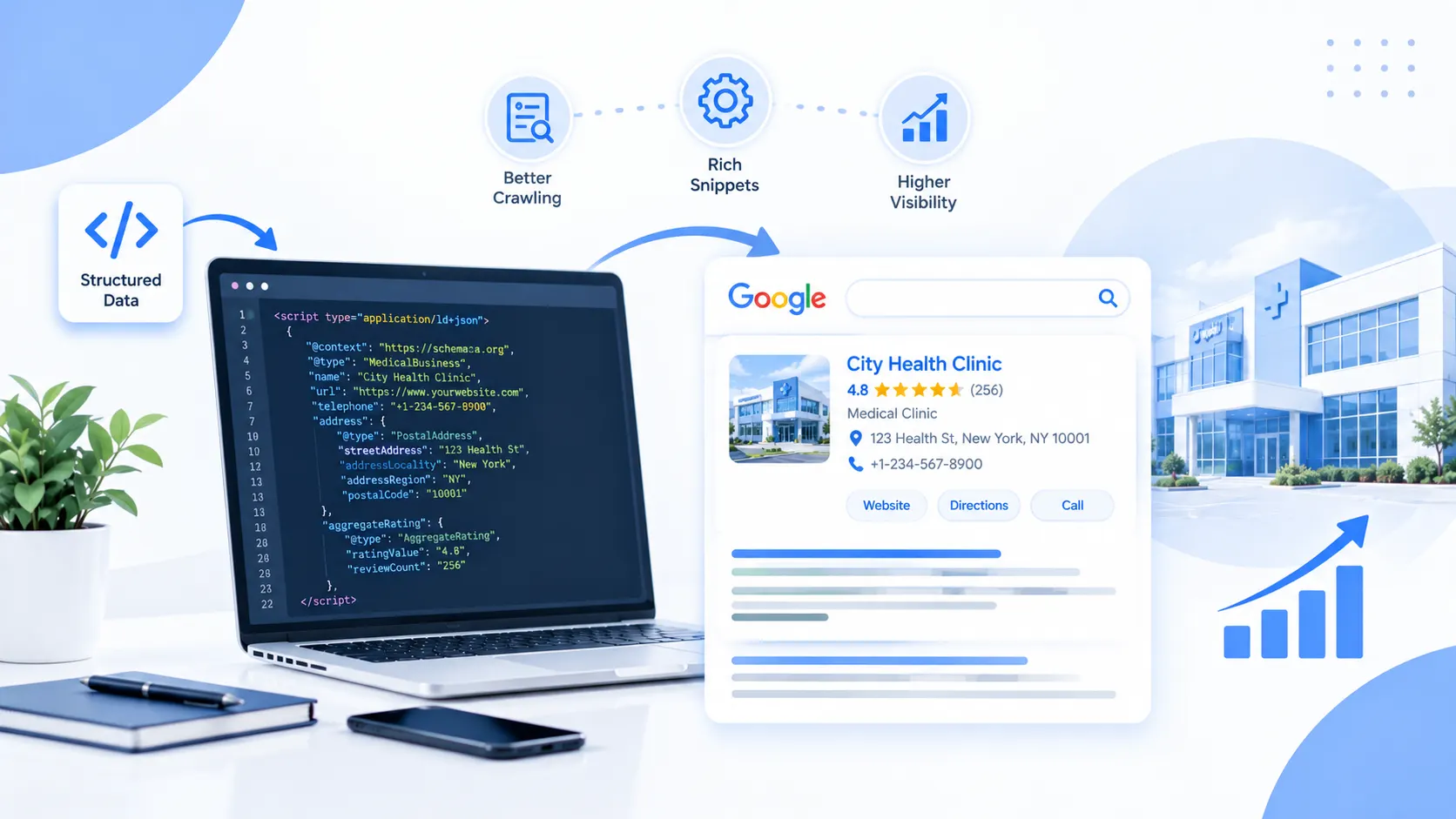
Rich results. Pages with valid schema become eligible, never guaranteed, for enhanced listings: star ratings, FAQ dropdowns, or breadcrumb trails in place of a plain blue link. Google’s own structured data guidelines are explicit that marking up a page doesn’t guarantee a rich result will display, only that it becomes eligible. Enhanced listings occupy more space on the results page and tend to earn a larger share of clicks than a standard listing sitting in the same position.
Local and map visibility. Healthcare search is overwhelmingly local. A patient searching “pediatric dentist near me” is querying against Google’s Map Pack, which draws heavily on structured, consistent location and category data. Nested LocalBusiness properties inside a medical-specific type give Google a stronger, more specific category signal than a generic business listing does.
Entity and knowledge graph reinforcement. Google increasingly organizes results around entities, not keywords. Distinct pages for each provider, condition, and service, correctly typed and cross-linked through schema relationships, help Google build a coherent picture of a practice as a network of related entities. That coherence supports how confidently the algorithm associates the site with the specialties and services it actually offers.
Is your practice telling three different stories online?
If your provider directory, schema markup, and Google Business Profile are out of sync, that’s the gap worth closing first. Let our team align your technical infrastructure, structured data, and local presence.
Structured Data and AI Overviews: What the Evidence Actually Shows
This is where a lot of healthcare marketing content overstates the case. Google’s own developer documentation states plainly that generative, AI-produced search results don’t require any special schema markup, and that there’s no dedicated schema.org type built specifically to earn a citation in an AI Overview. If a vendor promises “AI Overview schema,” treat that claim with skepticism.
What the correlational evidence does support is more modest, and more useful: sites with clean, consistent structured data tend to share the same characteristics that make them easier for AI systems to cite anyway, unambiguous entity names, verifiable credentials, direct-answer content structure, and information that matches across every place it appears. Structured data doesn’t cause AI citation. It’s one more consistent signal that a practice’s entities are well-defined, and well-defined entities are what both traditional ranking systems and generative answer engines reward. Treat schema as infrastructure that supports accurate content, not as a technique that substitutes for it.
Why Data Accuracy Matters More Than the Code
Structured data is only as useful as the facts inside it. A Physician entry that lists the wrong specialty, an outdated affiliation, or a phone number that doesn’t match a practice’s Google Business Profile does more harm than having no schema at all, because it creates a conflict search engines have to resolve, and they tend to resolve it by trusting the listing less.
This is also where healthcare SEO overlaps directly with the administrative side of running a practice. The name, specialty, board certification, and affiliation fields that belong in Physician schema are close to the same data points verified during provider credentialing and payer enrollment: NPI records, board certifications, hospital privileges, and network affiliations. For a closer look at what that verification actually covers, see what physician credentialing actually verifies. Practices that keep credentialing data current in one place have a much easier time keeping schema, their Google Business Profile, and payer directories in agreement. Practices that don’t tend to accumulate small inconsistencies across all three, and those inconsistencies are exactly what erode the trust signals structured data is supposed to build.
The same logic applies on the payer side. If a provider recently joined a practice, changed specialties, or completed a new payer enrollment, that update needs to reach the website’s schema at the same time it reaches internal records, not months later.
Common Healthcare Schema Mistakes to Avoid
- Markup that doesn’t match the visible page. Google’s guidelines are explicit that schema must describe what a user can actually see; padding a Physician entry with credentials or reviews that don’t appear on the page risks a manual action, not just a missed opportunity.
- Defaulting to generic LocalBusiness. It technically validates, but it discards every medical-specific property that makes a healthcare listing more useful to search engines.
- FAQ schema built for keywords instead of patients. A block of invented questions that don’t reflect real patient concerns reads as manipulative markup, and Google has scaled back how often FAQ rich results display in standard search anyway.
- Inconsistent NAP across systems. Different names, addresses, or specialties across schema, Google Business Profile, and credentialing records undermine entity recognition everywhere at once.
- Skipping validation. Syntax errors and missing required fields quietly disqualify markup from rich result eligibility, often with no visible warning on the page itself.
How to Implement and Validate Healthcare Schema
- Inventory pages by type. Homepage, provider pages, service pages, location pages, and blog content each need a different schema type, not one copy-pasted block.
- Match schema to page type, choosing the most specific subtype available rather than the broadest one.
- Write the JSON-LD. Below is a simplified example for a multi-provider clinic page; a real implementation should use complete, accurate details.
MedicalClinic Schema
{
  "@context": "https://schema.org",
  "@type": "MedicalClinic",
  "name": "Example Family Health Clinic",
  "url": "https://www.example-clinic.com",
  "telephone": "+1-555-010-1234",
  "address": {
    "@type": "PostalAddress",
    "streetAddress": "128 Oak Street",
    "addressLocality": "Springfield",
    "addressRegion": "IL",
    "postalCode": "62701",
    "addressCountry": "US"
  },
  "medicalSpecialty": ["FamilyMedicine", "Pediatric"],
  "employee": [
    {
      "@type": "Physician",
      "name": "Dr. Maria Alvarez, MD",
      "medicalSpecialty": "FamilyMedicine",
      "affiliation": {
        "@type": "MedicalOrganization",
        "name": "Example Family Health Clinic"
      }
    }
  ]
}- Confirm the markup matches the visible page exactly, field for field, before publishing.
- Validate with Google’s Rich Results Test and the Schema.org Validator, and fix every error before deployment, not after.
- Monitor the Enhancements reports in Search Console after launch to confirm the markup stays valid as templates and content change.
Practices juggling multiple providers, locations, or specialties often find the data-accuracy step harder than the code itself, which is where syncing structured data with existing systems through credentialing platform integrations saves the most ongoing effort.
Frequently Asked Questions
Does structured data guarantee higher rankings for a healthcare website?
No. Schema markup makes a page eligible for enhanced display and clearer entity recognition; it doesn’t override content quality, site authority, or relevance. Google states directly that valid markup doesn’t guarantee a rich result will appear.
Do I need FAQPage schema on every page?
No. Reserve it for sections that answer genuine, distinct patient questions. Adding it to pages without real Q&A content is treated as manipulative markup and adds little benefit, since standard search has already scaled back how often FAQ rich results display.
Can structured data help a practice get cited in AI Overviews or tools like ChatGPT?
Indirectly. There’s no dedicated schema type that guarantees an AI citation, but accurate, consistent structured data reinforces the same entity clarity and trust signals that make a source more citable in the first place.
What’s the difference between MedicalOrganization and Physician schema?
MedicalOrganization, or a subtype like MedicalClinic, describes the practice as an entity: its address, hours, and specialties. Physician describes an individual provider: their name, specialty, and affiliation with that organization. Most practices need both, nested together.
How often should healthcare schema be updated?
Whenever the underlying facts change: a new provider, a specialty change, a new location, or an updated credential. Schema tied to provider and credentialing data should update on the same schedule as internal records, not on a separate annual cycle.